
- Attractions by Region -
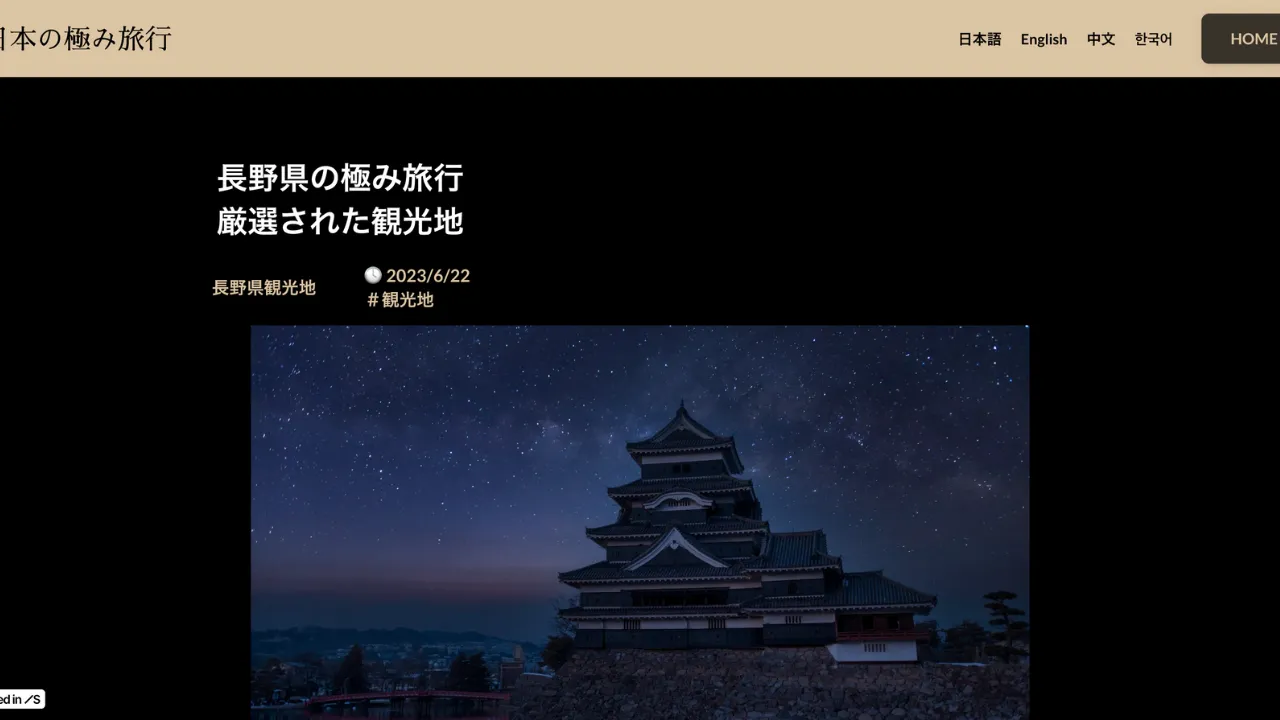
Start with three unmissable highlights of Shinshu—distilled for a first perfect trip.
National Treasure “Matsumoto Castle”
A rare five‑tier, six‑story keep in striking black. With the Northern Alps as its backdrop, the mirror‑like moat reflections made it the poster child of photogenic castles. Conquer the steep 67° stairs to feel like a feudal lord, then gaze over town from the Moon‑Viewing Turret.
Alpine Heaven “Kamikōchi”
A cool river valley at ~1,500 m cradled by the Hotaka Range and Mt. Yake. At dawn, the view of Mt. Yake from Kappa Bridge is screensaver‑worthy. Boardwalks meander through carpets of anemones and larch, and in autumn the perfect symmetry of the Hotaka mirrored on still water is breathtaking.
Jigokudani Monkey Park “Snow Monkeys”
The world’s only wild macaques that soak in hot springs—famous even on CNN. Their blissed‑out faces in rising steam are irresistibly human‑like. In mid‑winter, −10 °C air and billowing vapor craft a monochrome “snow‑bath” scene found nowhere else.
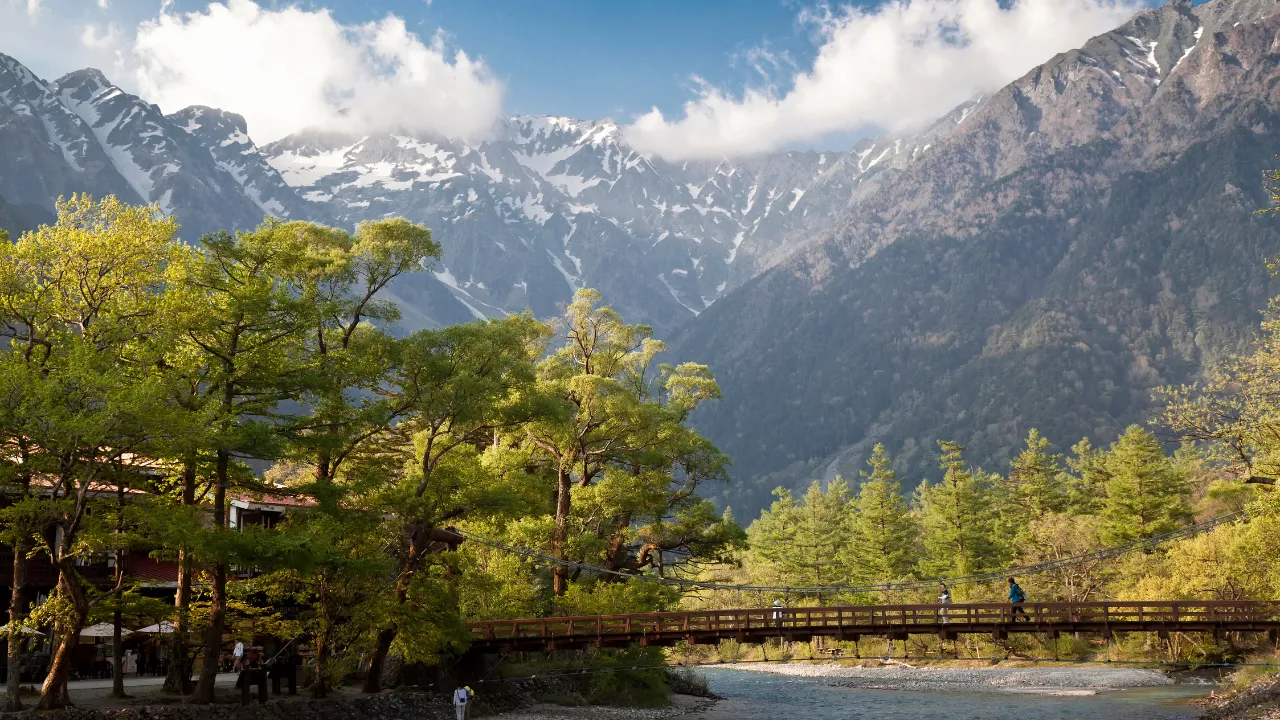
Kamikōchi is the premier alpine valley of the Northern Alps. Crystal‑clear Azusa River, the Hotaka massif, and boardwalks make it a beloved base for walks and hikes from snowmelt spring to fiery autumn.
A highland resort with jaw‑dropping alpine views
Kamikōchi is a flat river terrace around 1,500 m above sea level. The Azusa River flows through a pristine landscape beneath 3,000‑m peaks like the Hotaka Range and Mt. Yake. Cool even in midsummer, it was designated part of Chūbu‑Sangaku National Park in 1934 and later a Special Place of Scenic Beauty and a Special Natural Monument (1952). The British missionary Walter Weston helped popularize the “Japanese Alps” abroad from here.
Private cars are restricted; use shuttle buses or taxis from Sawatari (Nagano side) or Hirayu (Gifu side). Around the iconic Kappa Bridge you’ll find a visitor center, lodges, and hotels. Easy trails let first‑timers enjoy the scenery; lush greens in early summer and brilliant foliage in fall draw crowds of hikers.
The main season runs late April to mid‑November; the valley is effectively closed in deep winter. With morning mists and star‑packed skies, Kamikōchi enchants visitors with the quiet power of nature.
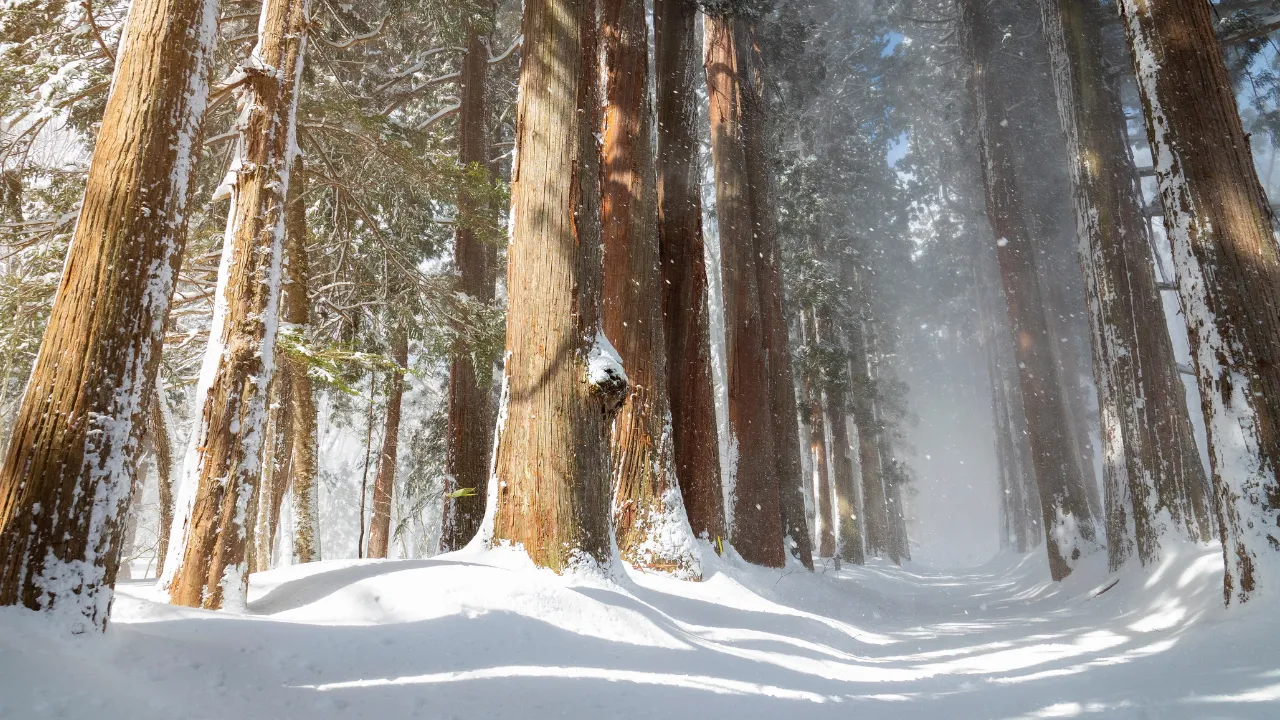
A sacred complex in the mountains of myth. The cedar‑lined approach to the Okusha (Inner Shrine) is profoundly solemn. Five shrines form a power spot long revered for mountain worship.
Where Shinto mythology and old‑growth forest breathe as one
Set in the Togakushi mountains of Nagano City, Togakushi Shrine comprises five shrines with origins back in the Heian era. Myth says when the sun goddess hid in a cave, the boulder hurled away landed here, giving the mountains their name. The complex has drawn pilgrims for centuries.
Each of the five has a different blessing: Chūsha (good fortune and studies), Hōkōsha (safe childbirth), Hinomikosha (performing arts), Kuzuryūsha (rainmaking), and the Okusha (heart’s desire) enshrining the mighty deity who opened the cave. The 2‑km approach to the Okusha—its latter half a corridor of 400‑year‑old cedars—radiates palpable energy. The sanctuary sits quietly beneath the jagged Togakushi peaks.
Togakushi was also famed as a shugendō training ground, with legends of ninja and tengu. After your visit, try local Togakushi soba—nature and mystery meet deliciously here across all seasons.
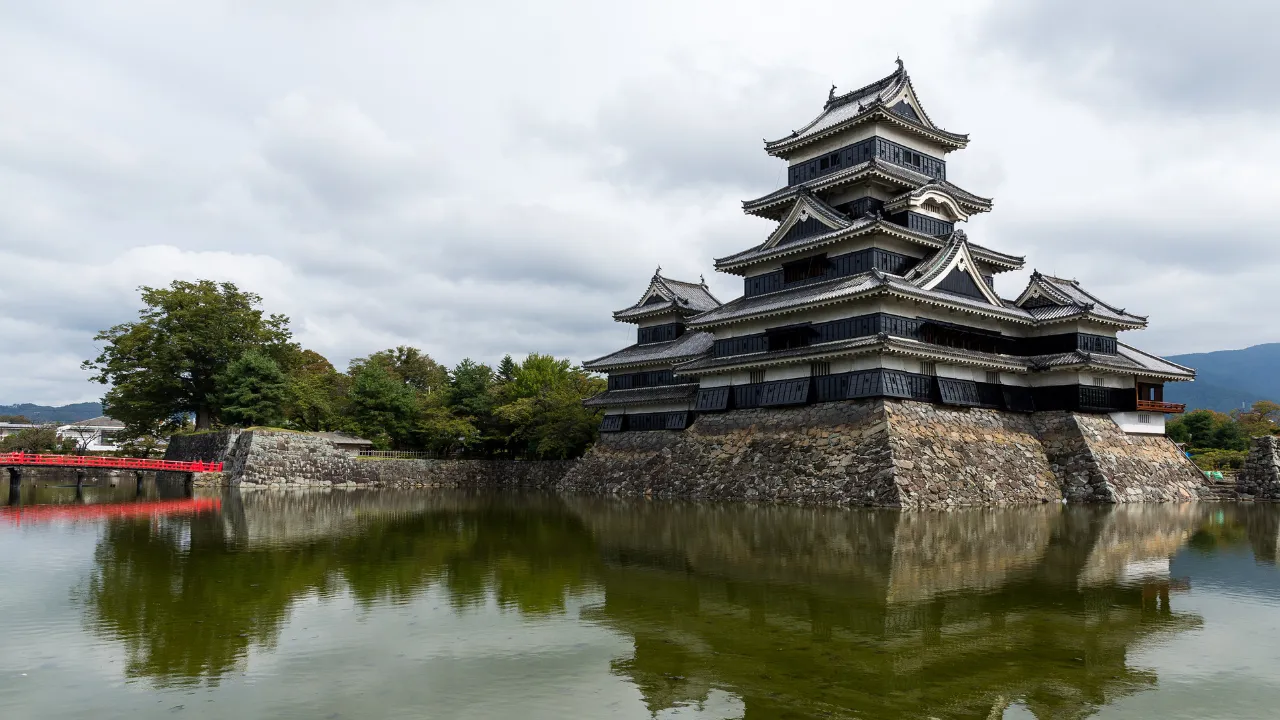
A National Treasure and one of Japan’s finest surviving castles with a five‑tier keep. Its elegant black exterior has earned the nickname “Crow Castle,” stunning in all seasons.
Grace and grit in a National Treasure
Built from the late Azuchi‑Momoyama into early Edo periods, Matsumoto Castle boasts a five‑tier, six‑story tenshu (keep). It is among the oldest surviving keeps and was designated a National Treasure in 1952.
The jet‑black weatherboards give it a dignified silhouette—thus the moniker “Karasu‑jō.” Seasonal scenes frame the keep: cherry blossoms in spring, fresh greens in summer, blazing foliage in autumn, and snow cover in winter.
Inside is a museum with displays of armor and matchlock guns. Climb the steep wooden stairs to feel the castle’s defensive design firsthand. Evening illuminations lend the grounds a dreamlike aura, and local festivals (taiko drums, Noh by torchlight) animate the precincts through the year.
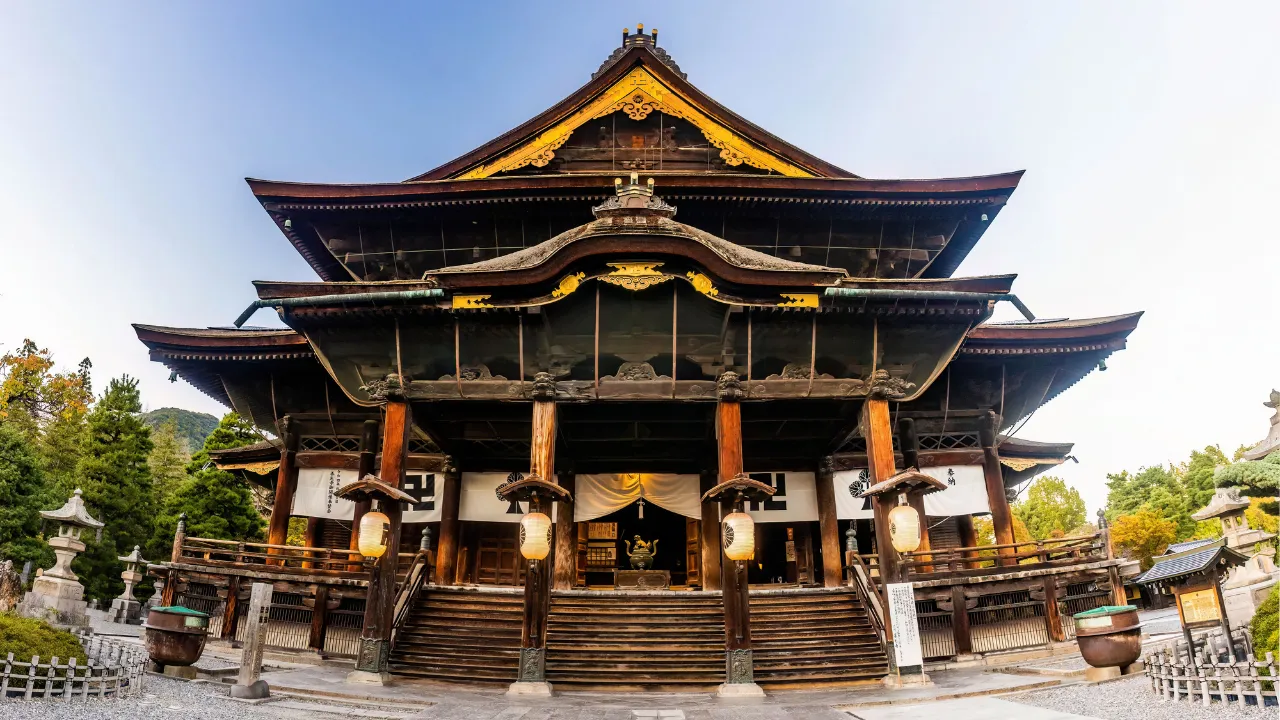
With 1,400 years of history, Zenko‑ji welcomes all regardless of sect. The pitch‑dark “Okaidan Meguri” under the main hall is a unique rite said to promise rebirth in paradise.
A temple to visit once in a lifetime
Tradition dates Zenko‑ji to the Asuka period. Housing a legendary triad Amida statue (a hidden principal image), it has long been a focal point of popular devotion—“Even from afar, visit Zenko‑ji at least once.” Operated jointly by the Jōdo and Tendai schools, its grand main hall (Edo mid‑period) is a National Treasure.
The famed “Okaidan Meguri” is a tactile pilgrimage through a completely dark corridor beneath the hall. Touching the “key to paradise” affixed within is believed to grant salvation—a thrilling rite for many visitors.
Every seven years (next in 2028), a special exhibition of the Maedachi Honzon (a replica of the principal image) draws millions. The long approach bustles with shops; try local specialties like oyaki dumplings and Shichimi chili as you soak in the temple‑town ambience.
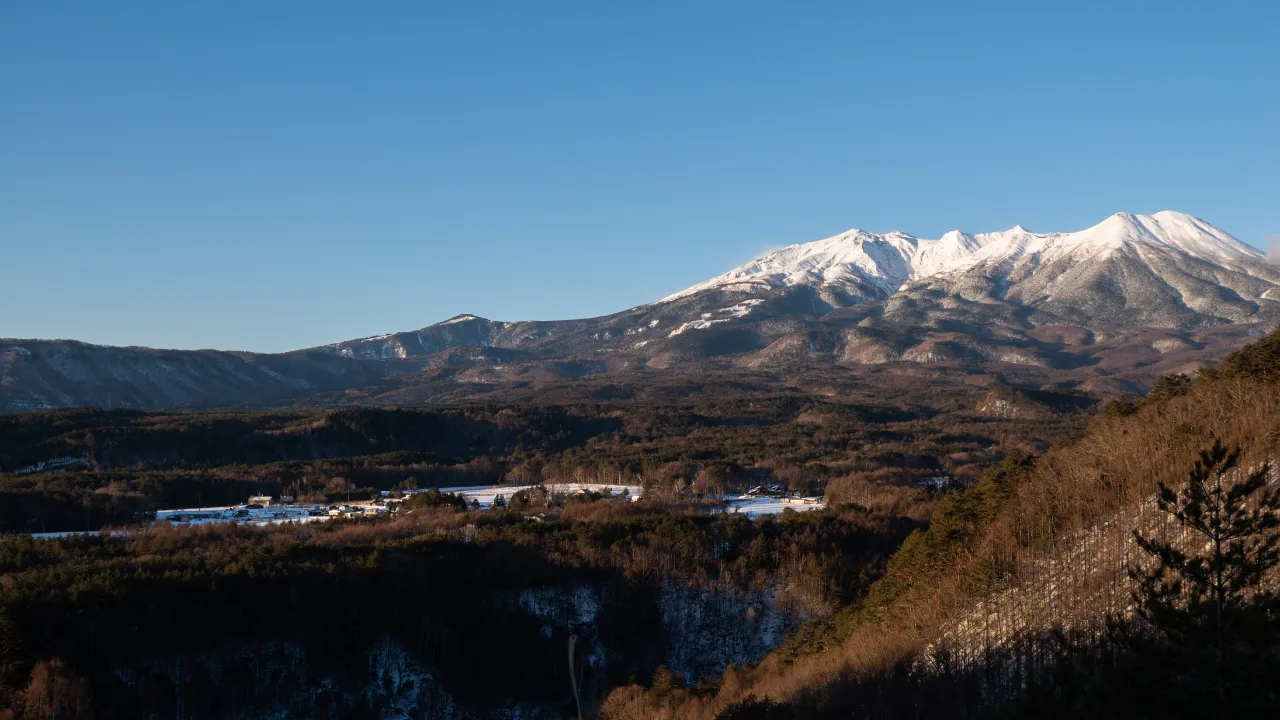
At 3,067 m, sacred Ontake has been a center of mountain worship since antiquity. An active volcano, its awe‑inspiring form radiates a mystic presence.
Faith and legend on a living volcano
Straddling Nagano and Gifu, Ontake is one of Japan’s most revered peaks. Traditions say the ascetic En no Ozunu climbed it in the 7th–8th century; in the Edo era, the Ontake‑kō lay movement spread nationwide, drawing pilgrims in white robes who still ascend today. Conch horns sound at dawn and dusk in villages like Otaki and Kiso, steeped in ritual.
Ontake remains active (notably erupting in 2014). Near the summit lie beautiful crater lakes like Nino‑ike and Sanno‑ike in deep alpine blue—mesmerizing in clear weather.
Summer offers non‑technical ascents with immense views of the Northern and Central Alps. Observe current restrictions and safety guidance while experiencing both the raw power of nature and Japan’s living mountain faith.
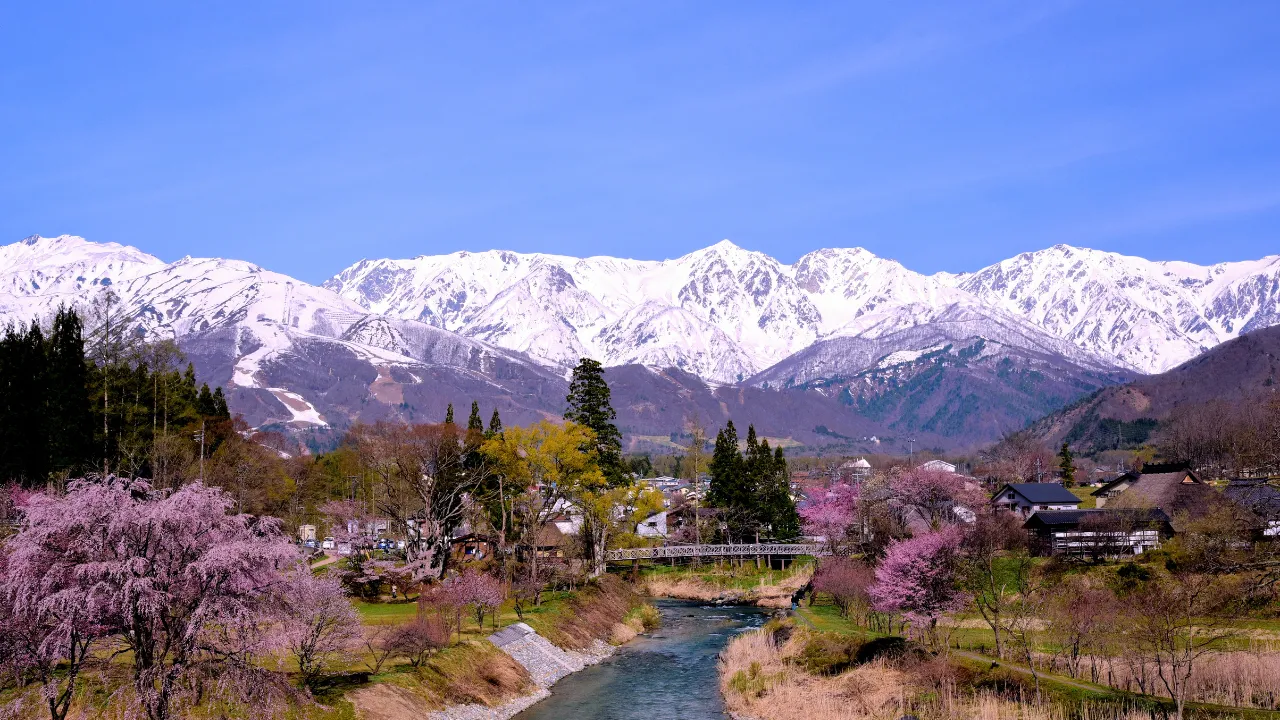
At the foot of the Northern Alps, Hakuba is a world‑class ski haven in winter and a paradise of alpine flowers and ridge hikes in summer—an all‑season mountain resort with global appeal.
Bold peaks and four‑season fun
Behind the village rise 3,000‑m peaks including the Hakuba Sanzan. In winter, powder snow and a variety of ski areas attract many overseas visitors; the 1998 Nagano Winter Olympics jump events took place here.
In the green season, gondolas whisk you to alpine meadows ablaze with flowers. From Happo‑one’s upper stations, mirror‑like ponds reflect the peaks. Elsewhere, suspension bridges at Ōide Park, canoeing on Aoki Lake, and countless trails keep nature lovers busy.
Year‑round hot springs and hearty local cuisine round out the appeal—Hakuba rewards return trips across seasons.

A glacier‑carved amphitheater on Mt. Kisokoma in the Central Alps. Japan’s highest‑elevation ropeway brings you quickly to flower meadows and sea‑of‑cloud panoramas.
“Sky meadows” above the clouds
Formed ~20,000 years ago by glaciation, the half‑bowl cirque spreads at ~2,600 m on Mt. Kisokoma (2,956 m). From Komagane, the ropeway ascends ~950 m in about seven minutes to Senjojiki Station, the country’s highest station—granting easy access to true alpine scenery.
Summer blooms with carpets of delicate highland flowers such as Komakusa and Chinguruma against lingering snow. In autumn, slopes blaze in reds and golds, and on clear days you may even glimpse Mt. Fuji. If you’re lucky, a vast sea of clouds engulfs the valleys below—a once‑in‑a‑lifetime view.
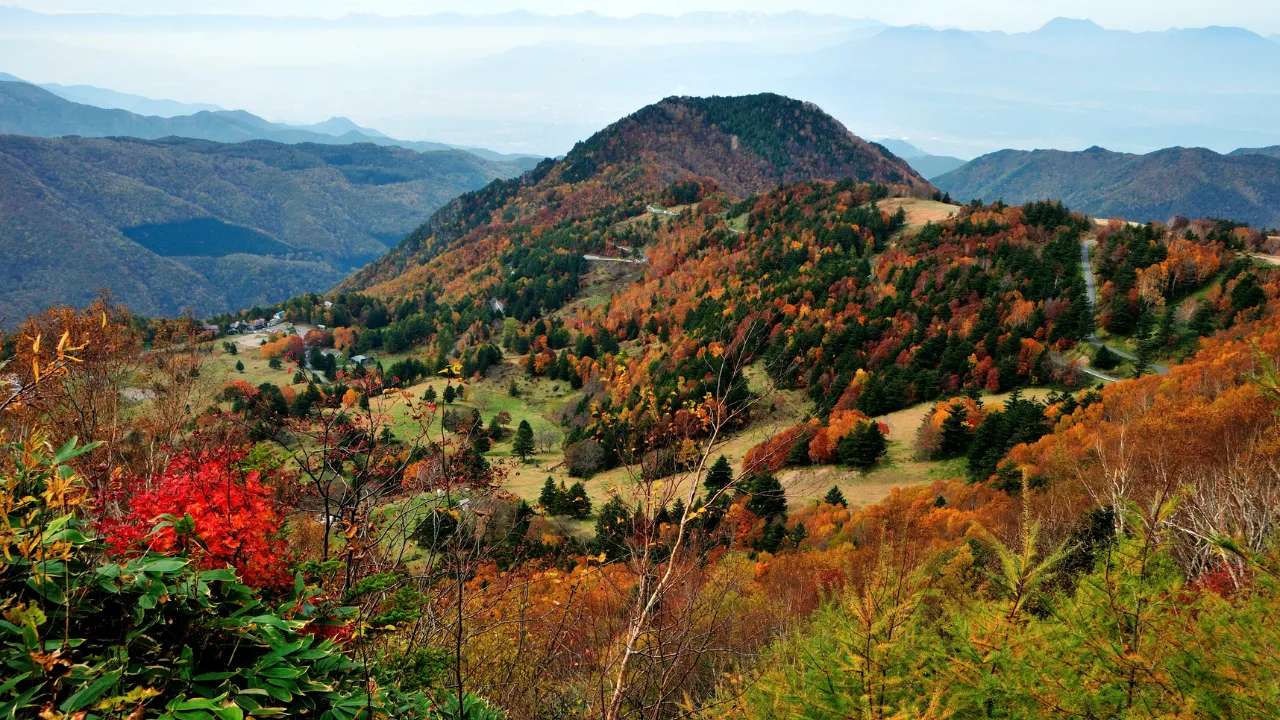
A vast upland between 1,500–2,000 m dotted with ponds and wetlands. Cool hikes in summer, superb snow in winter—Japan’s highland resort at scale.
One of Japan’s largest upland resorts
Within Joshin’etsu Kōgen National Park, Shiga Kōgen hosts 70+ ponds and marshes born of volcanic activity. Boardwalks lead through flower‑rich wetlands; climbs of Mt. Shiga and Mt. Iwasuge reward with ridge‑top views.
In winter, 19 interconnected ski areas form a powder playground; the 1998 Nagano Olympics hosted alpine events here. A UNESCO Biosphere Reserve since 2014, Shiga balances conservation and tourism—spectacular in every season.
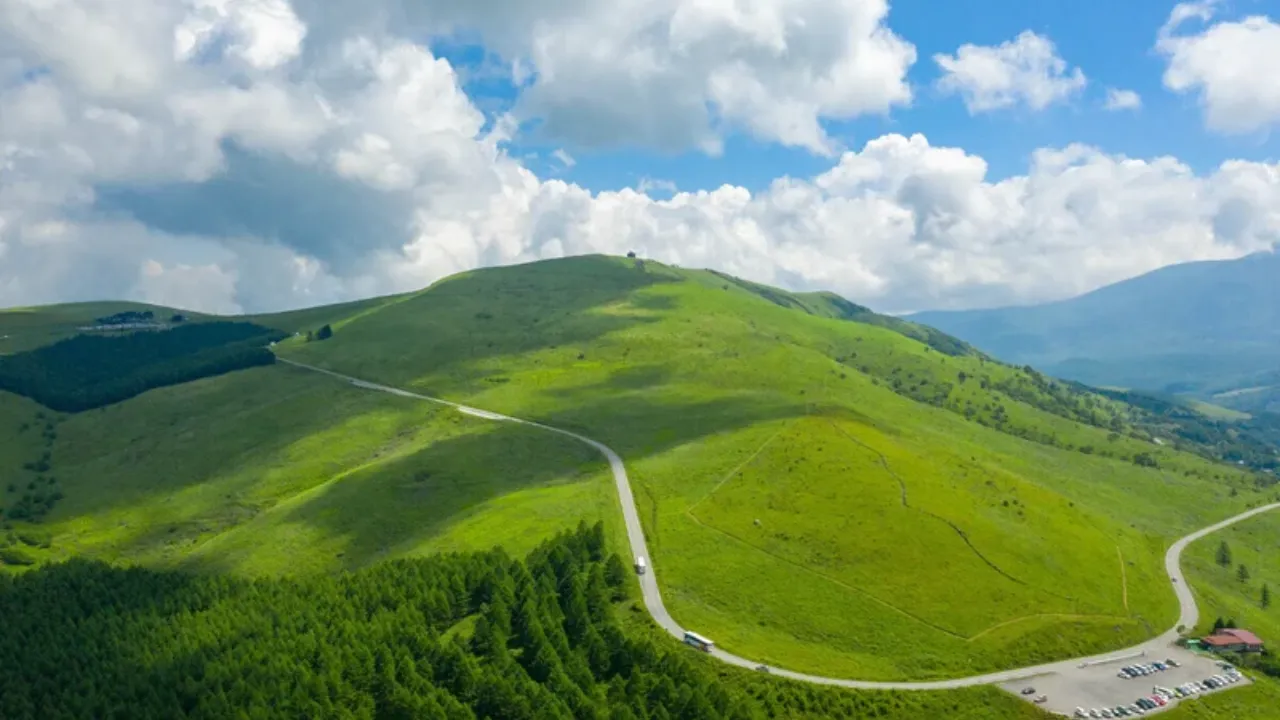
A 76‑km scenic drive threading the highlands of Tateshina, Kirigamine, and Utsukushigahara. Ever‑changing panoramas make for a cathartic cruise.
One of Japan’s iconic highland roads
The Venus Line links Suwa and Ueda through high plains at 1,400–2,000 m. Viewpoints abound—Yatsugatake and the Alps often fill the horizon. In summer, Kirigamine’s daylilies paint the meadows yellow; at Utsukushigahara, grazing cattle and the “Tower of Beauty” watch over 360‑degree vistas.
Spring green, autumn foliage, and winter snows each transform the drive. Lakes like Shirakaba and Megami, hot springs, viewpoints, and roadside stations keep the stops plentiful for drivers, riders, and cyclists alike.
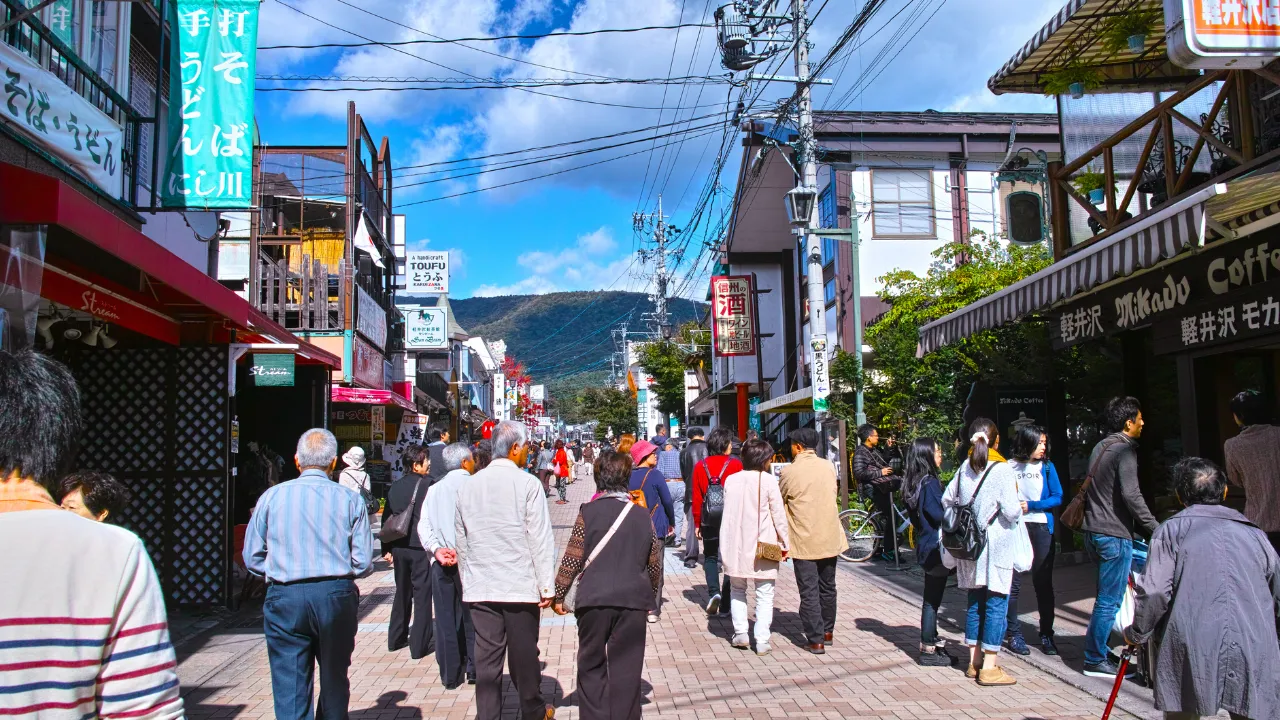
A retro shopping street that preserves Karuizawa’s summer‑resort culture. Bakeries and jam shops line the stone‑paved road—expect queues from 7 a.m. on peak days.
Missionaries and royals shaped this “haikara” strip
From the Meiji era, foreign missionaries built villas and churches here, sparking a wave of Western breads and berry jams. In the Shōwa era a royal residence boosted elite summer visitors, and upscale cafés and boutiques followed—today’s Kyu‑Karu Ginza was born.
At the far end stands the 1905 wooden Gothic Shaw Memorial Church, a beloved photo spot with its white walls and red gabled roof. Up to 20,000 people visit on a peak summer day, but early mornings are quiet and misty—perfect for grabbing a fresh baguette and picnicking under the trees.
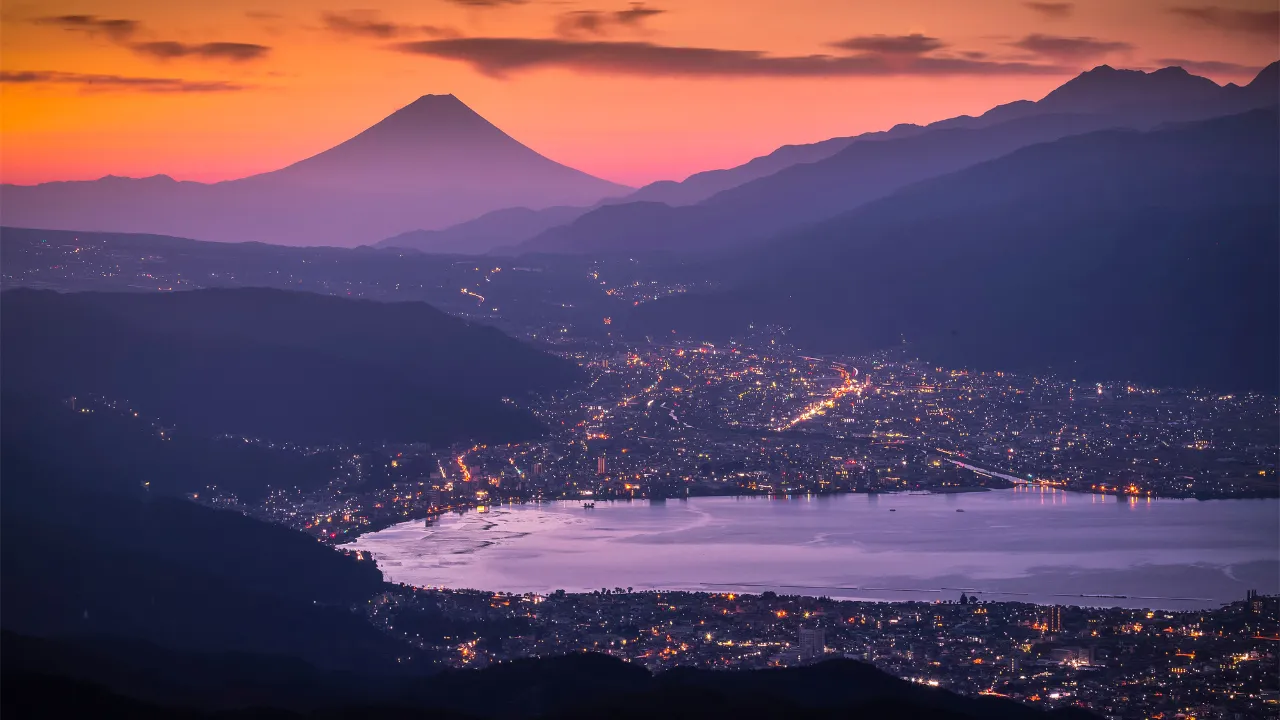
Nagano’s largest lake. Fireworks in summer (40,000 shells!) and the winter ridge of cracked ice called “Omiwatari” give it strikingly different seasonal faces.
Where ice “parts” for the gods
When Suwa fully freezes in severe winters, day‑night temperature swings heave the ice into long pressure ridges called Omiwatari. Priests then read the shapes as omens for the year—a tradition that lives on today.
On August 15, the Lake Suwa Fireworks Festival shoots some 40,000 shells—among Japan’s largest displays. Wide starmines and waterborne fireworks paint both sky and lake, drawing crowds of around half a million.
A 16‑km cycling loop circles the shore—flat and family‑friendly, about 90 minutes by rental bike. Nearby stand Suwa Taisha shrines and the historic Katakura Hall bathhouse. Cruises and footbaths round out a relaxed lakeside day.

Near Shibu Onsen, this park is famed for wild Japanese macaques bathing in hot springs amid winter snows—the “snow monkeys” beloved worldwide.
Wild monkeys enjoying a hot‑spring soak
Set deep in Yamanouchi’s mountains at ~850 m, Jigokudani became famous in the 1960s for photos of macaques warming in the open‑air baths. In mid‑winter, temperatures drop below −10 °C; the monkeys likely began bathing to cope with the cold, and the sight charmed the world.
It’s a ~30‑minute walk on a forest path (snow boots needed in winter). Outside winter you’ll see monkeys frolic in the river and the valley cloaked in fresh greens or fall colors. The monkeys are accustomed to humans, allowing close observation—do not feed them and quietly respect their wild ways.
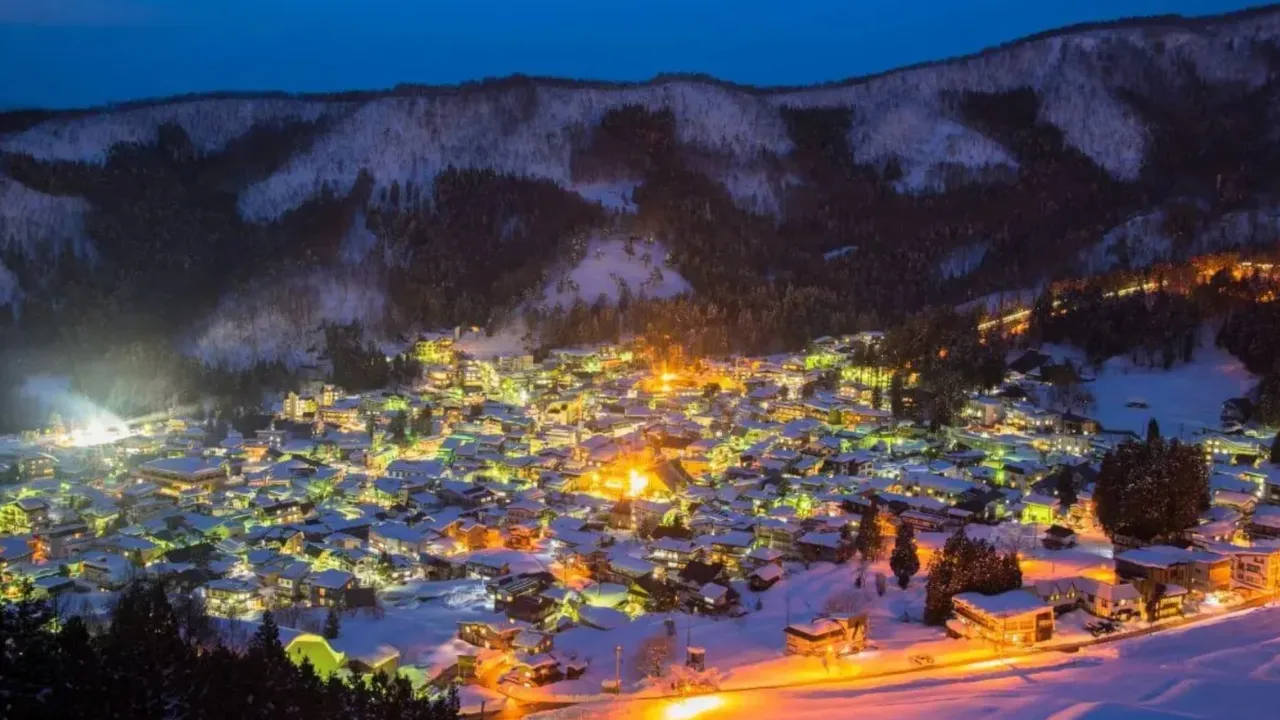
Thirteen communal bathhouses make for classic “sotoyu” hopping. A lively ski town in winter, Nozawa is also famed for the dramatic Dosojin Fire Festival each January.
Hot‑spring town of bathhouse hopping and blazing festivals
Nestled in northeastern Nagano, Nozawa’s hot springs date back at least to medieval times. Thirteen quaint wooden bathhouses are free to use, and strolling stone lanes in yukata feels like stepping into an old print.
The sulfur‑tinged waters run hot and are even drinkable at certain spots. Local staple Nozawana pickles are traditionally made using hot‑spring heat—flavors of life tied to the springs themselves.
January 15 brings the Dosojin Fire Festival (National Important Intangible Folk Cultural Property), where a towering wooden shrine is fiercely defended and then set ablaze—an unforgettable winter spectacle alongside top‑tier skiing.
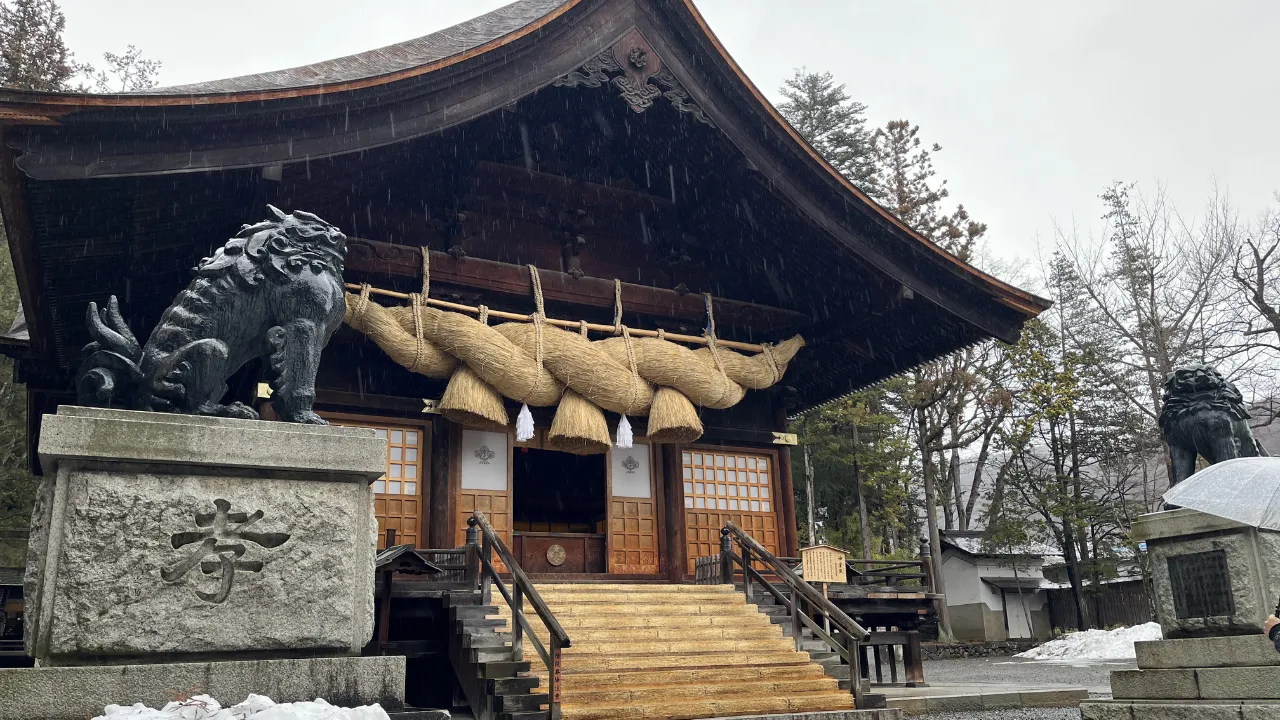
Among Japan’s oldest shrines, Suwa Taisha comprises four sanctuaries around Lake Suwa. Known for the epic Onbashira Festival, where giant logs are raised at each sanctuary.
Guardian of the Suwa region for millennia
The collective name “Suwa Taisha” covers Upper Shrine (Honmiya, Maemiya) and Lower Shrine (Harumiya, Akimiya) around the lake. The principal deities include Takeminakata, a martial and agricultural god from myth. Warriors prayed here for victory; locals for wind and water.
Every seven years the Onbashira Festival renews the precincts with four massive sacred logs at each shrine. The constant presence of these towering pillars—over 10 m—gives Suwa an unmistakable aura. At Honmiya, note the unique “Suwa‑zukuri” architecture without a main sanctuary building.
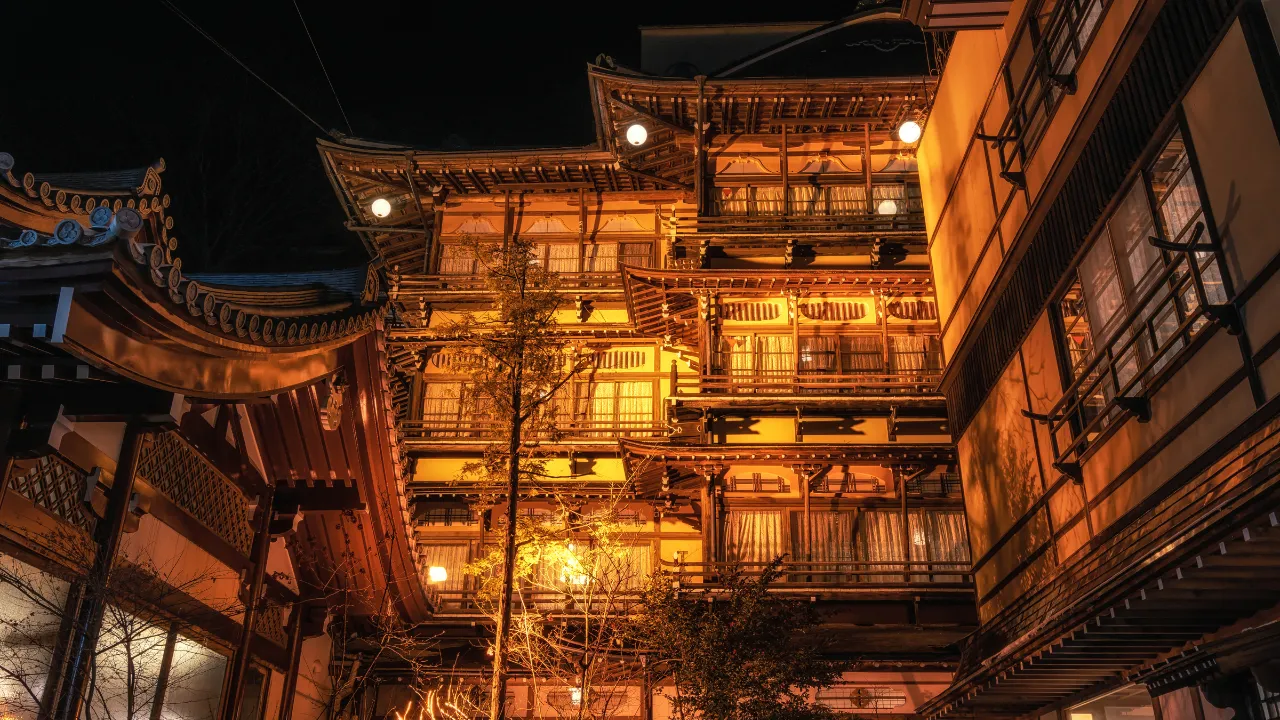
Stone lanes and wooden inns evoke centuries of hot‑spring history. Nine bathhouses invite yukata‑clad guests on a leisurely soaking stroll—also a base for the Snow Monkeys.
Nostalgic town made for onsen wandering
With 1,300+ years of history, Shibu Onsen thrived alongside neighboring Yudanaka as a healing spa town; writers and artists left traces of their stays. Narrow lanes lined with three‑story wooden ryokan preserve a bygone atmosphere.
Nine small communal baths dot the district—keys are lent to staying guests to sample them all. Complete the circuit and you’ll receive a “fulfillment” charm. Don geta‑clogs at night and join the gentle footfall echoing through lantern‑lit alleys.
The famed Kanaguya ryokan is rumored (unofficially) to have inspired the bathhouse in Spirited Away. Shibu also serves as a convenient hub for visiting Jigokudani Monkey Park.

Sheets of spring water emerge across a 70‑m curtain. Summer night illuminations lend it a magical glow.
A lace of pure white that never muddies
Though only ~3 m high, the broad veil of water resembles countless threads of silk. Fed by groundwater, the flow remains clear even after rain. The negative ions and cool air make this a refreshing summer stop.
The flat walkway is sandal‑friendly. In July–August, colored lights transform the falls at night. The drive along the Shiraito Highland Way features viewpoints and cafés, with Asama volcano scenery en route.
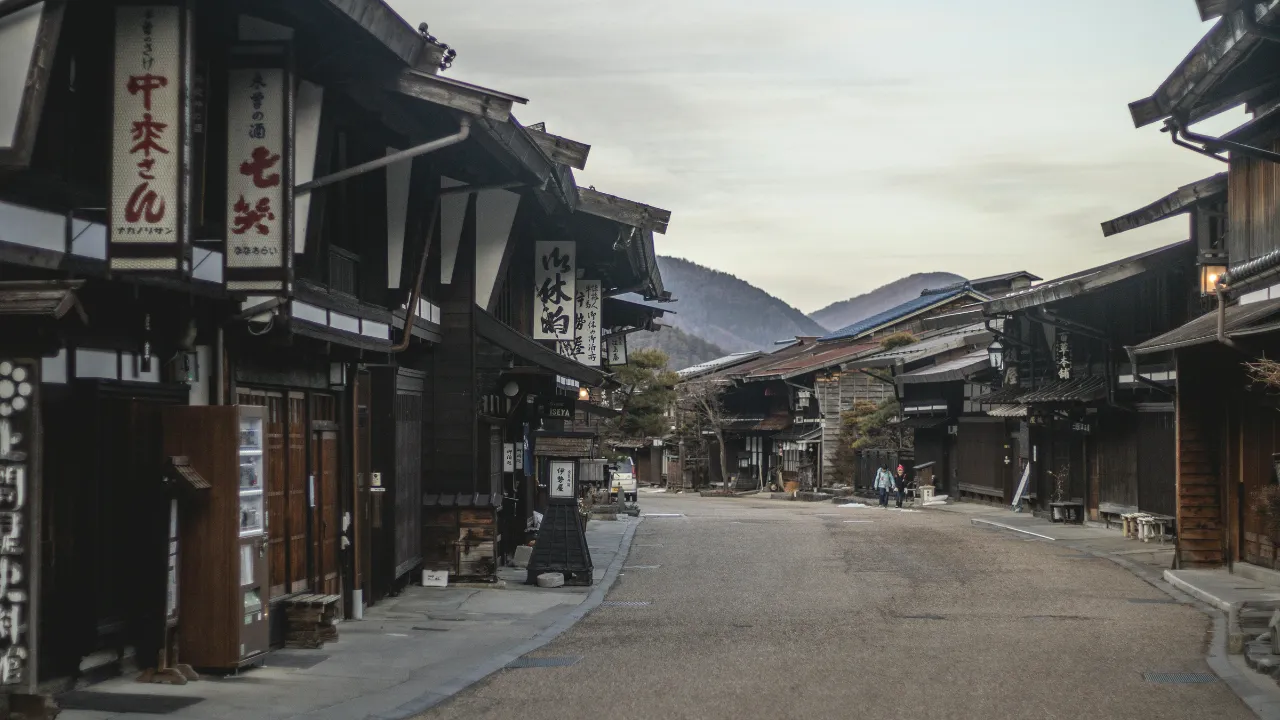
The longest post town of the old Nakasendō, Narai preserves a sweeping streetscape of Edo‑period houses—perfect for a history walk and traditional craft shopping.
The Nakasendō’s most atmospheric post town
Narai was the 34th of the 69 stations on the Nakasendō, perched near the tough Torii Pass. Over 1 km of townhouses survive, earning it the nickname “Japan’s longest post town.” Black‑sheened boards and lattice facades evoke the bustle of travelers past.
It’s a living town—browse lacquerware workshops, folkcraft stores, cafés, and eateries. Try gohei‑mochi skewers or kusa‑mochi as you stroll. At the north end stands the Kiso no Ōhashi, one of Japan’s oldest wooden bridges, lending further charm. June brings the Narai‑juku Festival with Edo‑style processions.
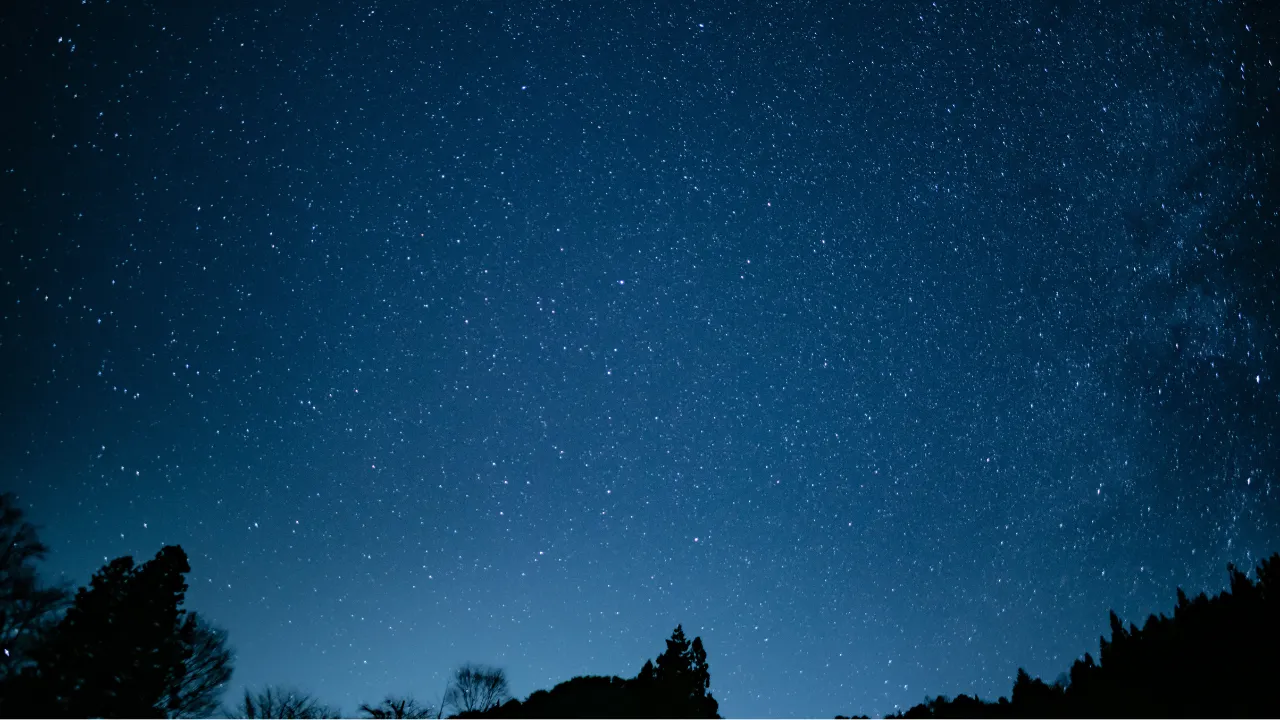
Winner in national dark‑sky surveys, this southern Nagano hamlet runs night tours via ropeway to ~1,400 m, where the Milky Way stretches overhead.
Milky Way nights on a mountaintop deck
Achi’s high elevation and low light pollution won it top marks in Japan’s star surveys. The “Heavenly Paradise Night Tour” rides the Fujimidai Ropeway to a 1,400‑m lookout for guided constellation shows and naked‑eye stargazing in summer.
Recline on star‑viewing seats as meteors streak by on lucky nights. Many visitors pair the experience with a soak at Hirugami Onsen below—alpine stargazing and a hot bath make for bliss.
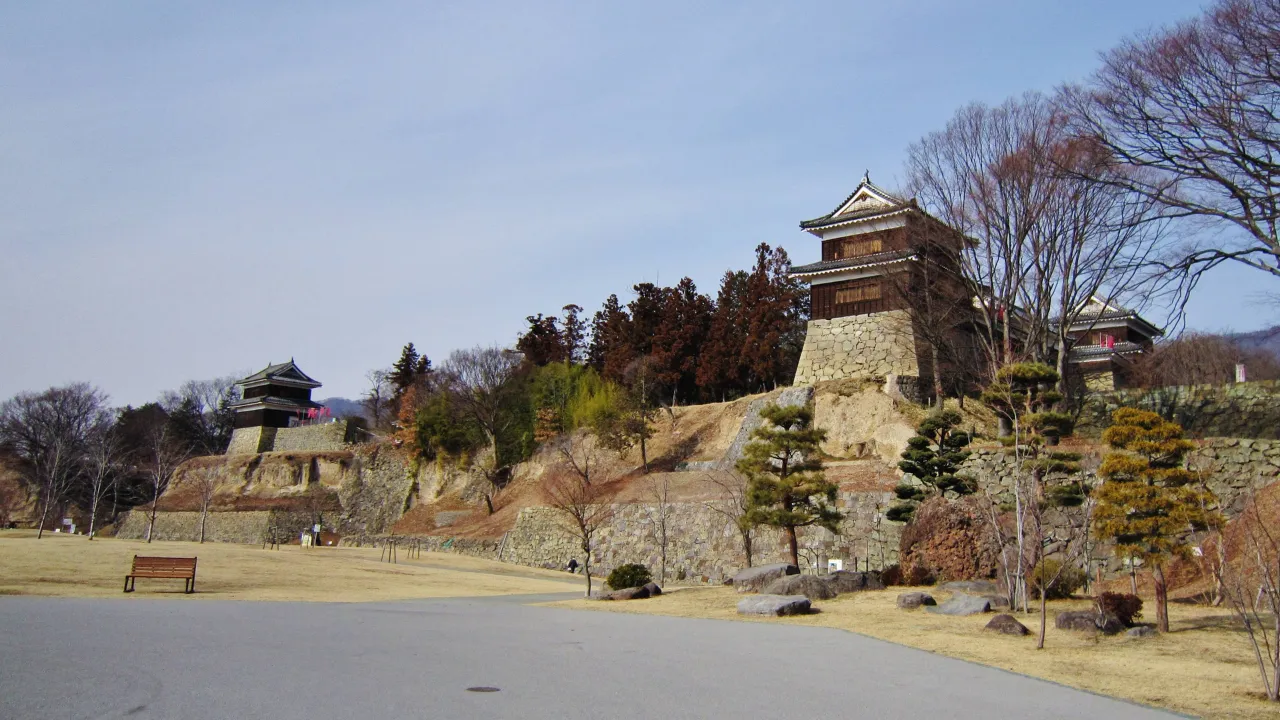
Built by the Sanada clan, Ueda famously repelled the Tokugawa army twice. Today the grounds are a park with restored gates and towers—superb for cherry blossoms.
The “unconquered” stronghold of the Sanada
Constructed in 1583 by Sanada Masayuki on natural defenses between the Chikuma and Tō rivers, Ueda earned a fearsome reputation. In 1585 and again in 1600, the Sanada thwarted superior Tokugawa forces—the second time delaying Hidetada’s army en route to Sekigahara.
Today, stone walls, earthworks, and moats remain in fine condition. Rebuilt turrets and the East Gate revive the feel of the period; Sanada Shrine sits within the grounds. Spring sees ~1,000 cherry trees in bloom; autumn colors and winter snows offer year‑round charm.
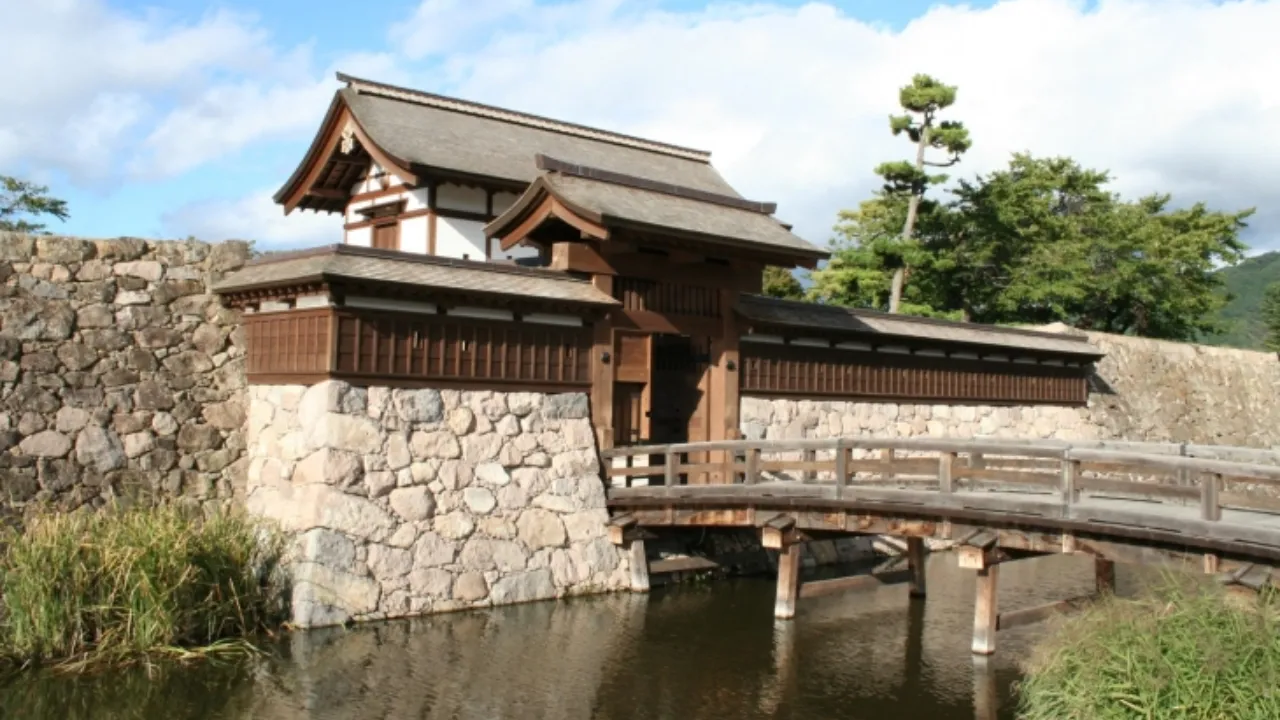
Once the Sanada’s domain town, Matsushiro preserves Edo‑period sites like the castle ruins and the Sanada Residence—an elegant pocket of samurai culture near Nagano City.
Castle‑town of the Sanada, 100,000 koku
South of Nagano City, Matsushiro flourished as the Sanada clan’s seat through the Edo era. The castle (formerly Kaizu‑jō) features earthen ramparts, stoneworks, and moats; reconstructed gates and bridges add period atmosphere.
Wander to the Sanada Residence (Important Cultural Property), the old domain school “Bunbu Gakkō,” and other samurai houses and temples. Autumn’s Matsushiro Festival parades armored warriors through the streets—a living history scene.
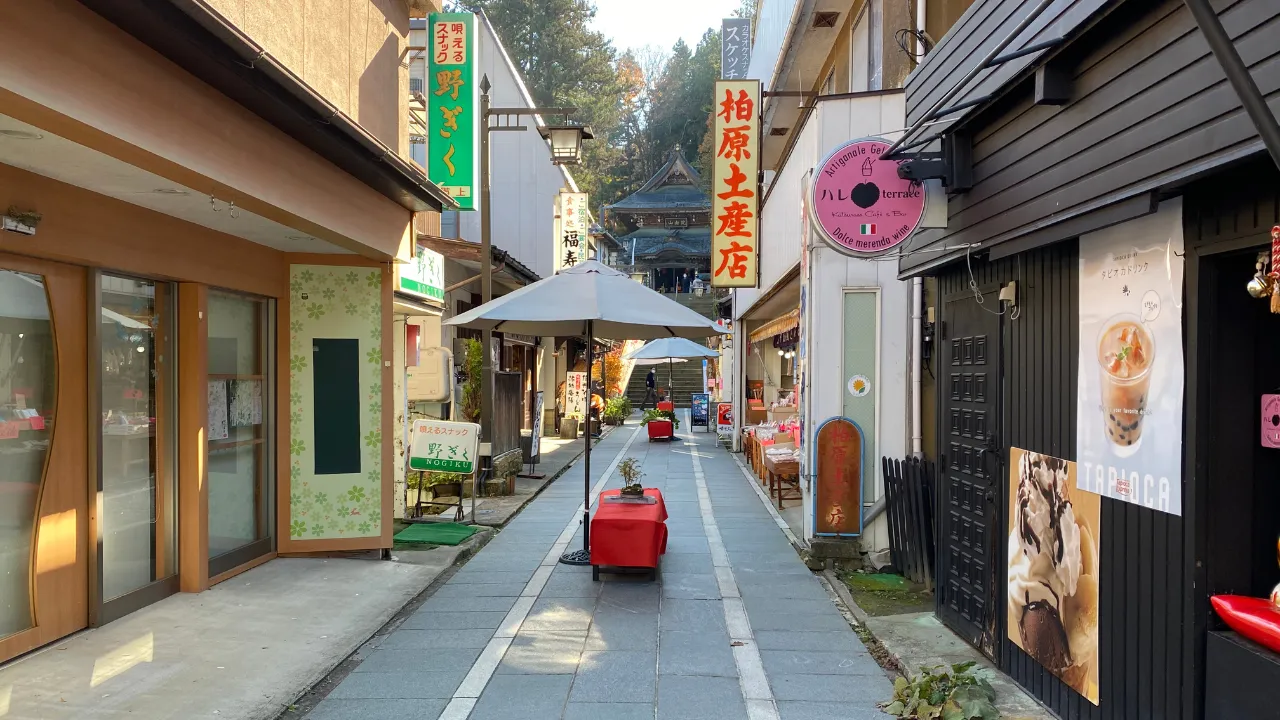
Called the “oldest onsen in Shinshu,” Bessho is a quiet spa town loved by warriors and poets. Three public baths and nearby temples make a gentle, contemplative escape.
An ancient spa steeped in faith and culture
Bessho traces its origins to antiquity; by medieval times it was a noted healing site. The Sanada and Takeda are said to have bathed here. The mildly sulfurous waters feel silky, and three communal baths—Ōyu, Daishi‑yu, Ishiyu—each have their own character.
Nearby, Anraku‑ji’s National Treasure octagonal three‑story pagoda and Kitamuki Kannon beckon history lovers. Slow walks, temple bells, and a restorative soak—Bessho is serenity itself.
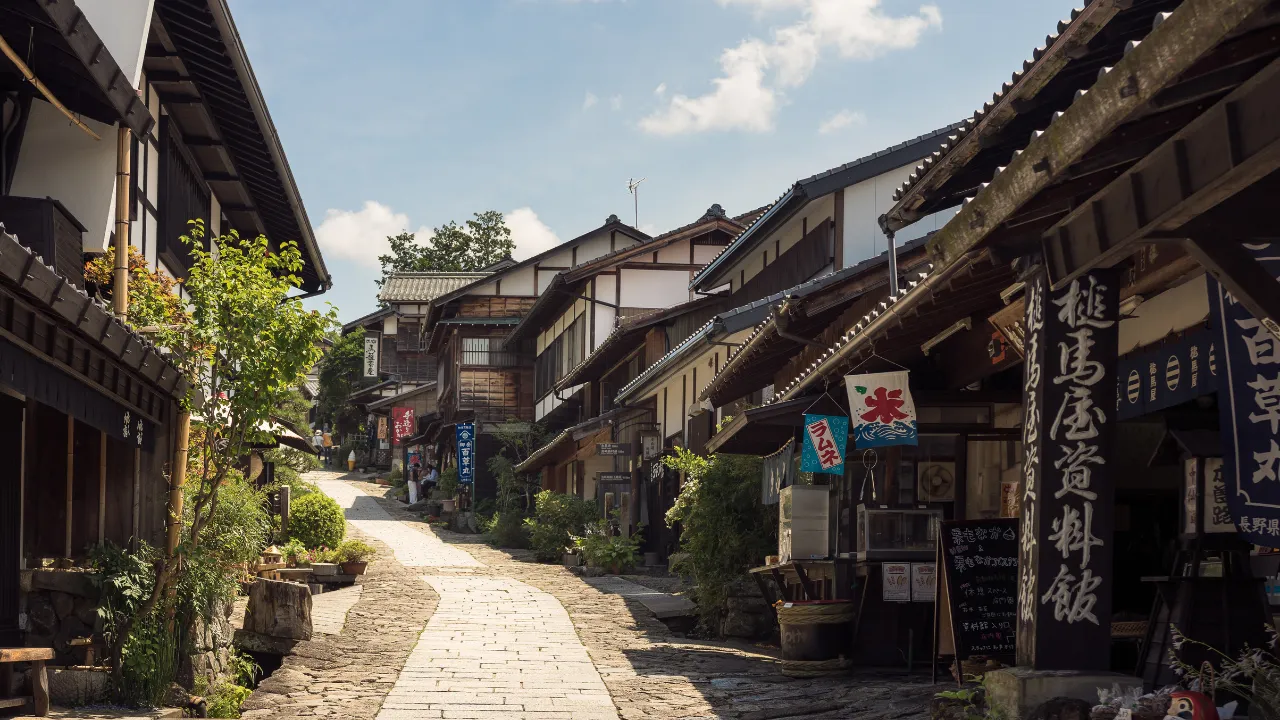
Japan’s first townscape preservation success story. With buried power lines and restrained signage, Tsumago feels like time travel to Edo.
A post town saved by its people
Tsumago, the 42nd Nakasendō post town, declined after modern routes shifted. In the 1970s locals enacted a pioneering charter—“Don’t sell, don’t rent, don’t destroy”—and restored the streetscape. Wooden signs, stone slopes, and low eaves recreate Edo ambience.
Tour the restored Honjin and Wakihonjin (inns for feudal lords), and learn the road’s history at the museum. Sample Kiso treats—gohei‑mochi and chestnut sweets—and hike the classic trail to Magome in Gifu for an Edo‑era walking experience.
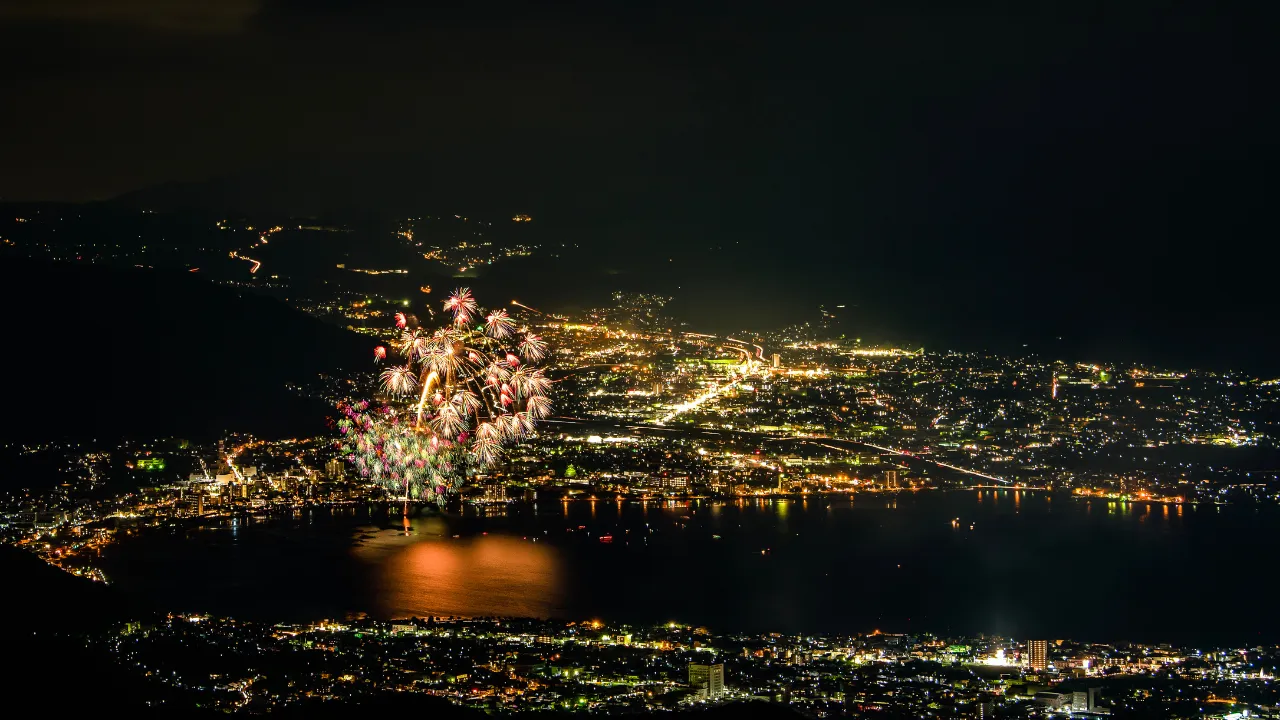
Held every August 15, one of Japan’s largest fireworks shows. About 40,000 shells ignite across sky and lake—waterborne starmines and a 2‑km Niagara cascade thrill the senses.
40,000 blooms over a mountain‑ringed lake
Begun after WWII, the festival now draws 500,000 onlookers. Suwa’s amphitheater‑like basin amplifies the thunder of starmines. Water‑level fan bursts and giant aerial shells open to 500‑m diameters; the finale turns night into day.
Reserve paid seating or join spectators around the shore. With reflections rippling across the lake, it’s a signature night of the Nagano summer.
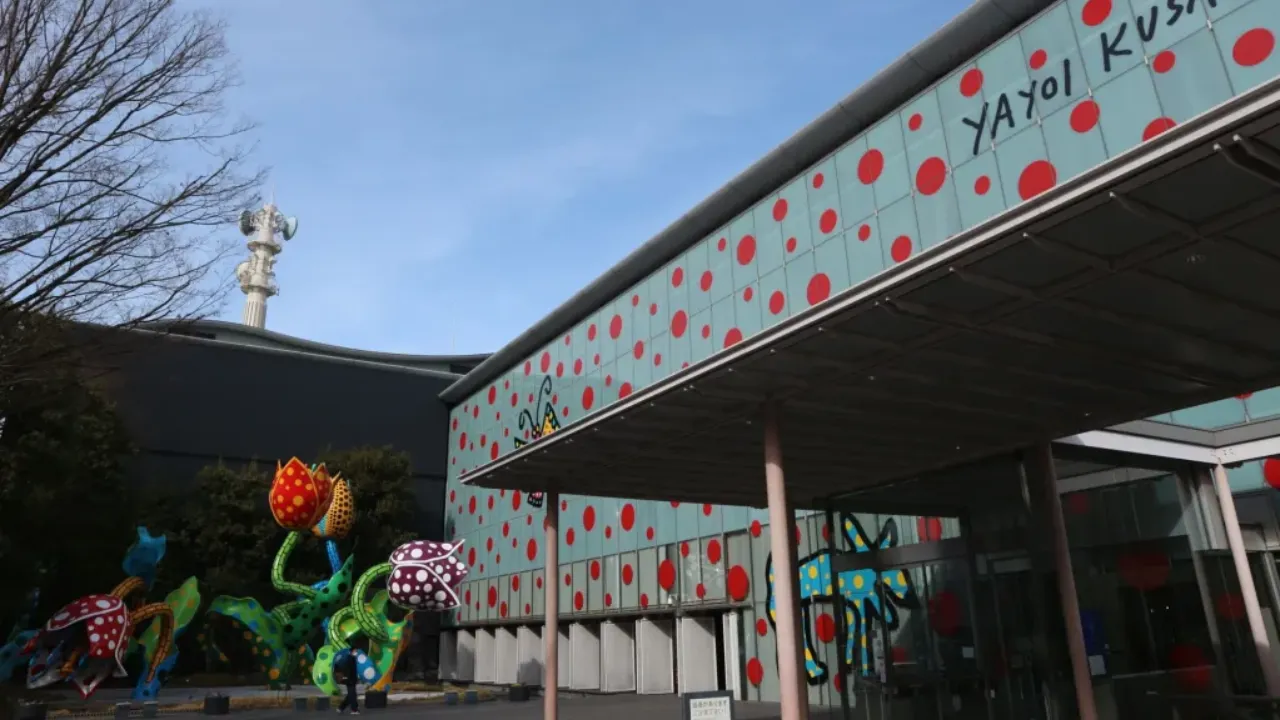
Home to major works by Yayoi Kusama, who hails from Matsumoto. A giant polka‑dot pumpkin greets you; permanent exhibits and local artists round out a vibrant program.
Yayoi Kusama’s dots meet the Alps
Opened in 2002, the city museum holds numerous Kusama works, with polka‑dot installations extending into everyday corners. Exhibitions also feature Nagano‑linked artists like painter Yamamoto Kanae and printmaker Akiyama Iwao, plus community art.
Cafés and shops cluster nearby; JR Matsumoto Station is ~10 minutes on foot—an easy cultural stop during castle‑town strolls.

A spectacular 37.2‑km traverse of the Northern Alps via six transport modes—from cable cars to ropeways—to the high plateau of Murodō (2,450 m). Famous for spring’s 20‑m snow corridor and summer’s roaring dam releases.
Ride through an alpine world
Linking Ōgisawa (Nagano) and Tateyama (Toyama), the route ascends ~2,000 m in total. Snow walls tower in April–June; in July–August, green meadows and the thunder of Japan’s tallest dam (Kurobe, 186 m) captivate; in September–October, flaming foliage sweeps the ridges.
Transfers between cable cars, a trolleybus through a mountain tunnel, highland buses, and a ropeway become part of the adventure. Even non‑hikers can savor the high‑alpine environment in comfort.
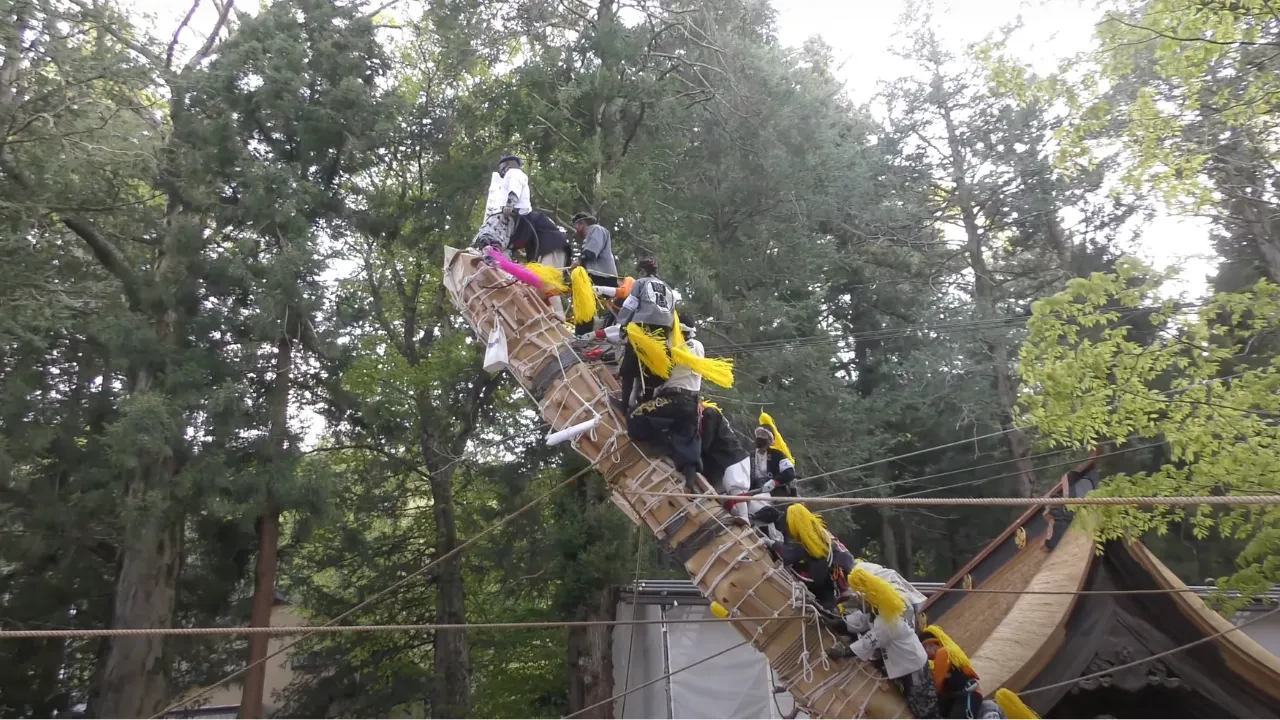
Held every seven years (Tiger & Monkey years), the Onbashira renews Suwa’s sacred pillars. The dramatic “Ki‑otoshi” log‑riding down steep slopes is famed worldwide.
“The Festival of Festivals,” once in seven years
The Onbashira dates back over a millennium. Sixteen monumental fir logs—up to 17 m long and 10+ tons—are felled and hauled by hand from the mountains to the four Suwa sanctuaries.
During “Ki‑otoshi,” the logs are slid down steep slopes with brave youths astride, while clouds of dust and cheers erupt. The logs are then raised at the four corners of each shrine, standing guard for the next seven years.
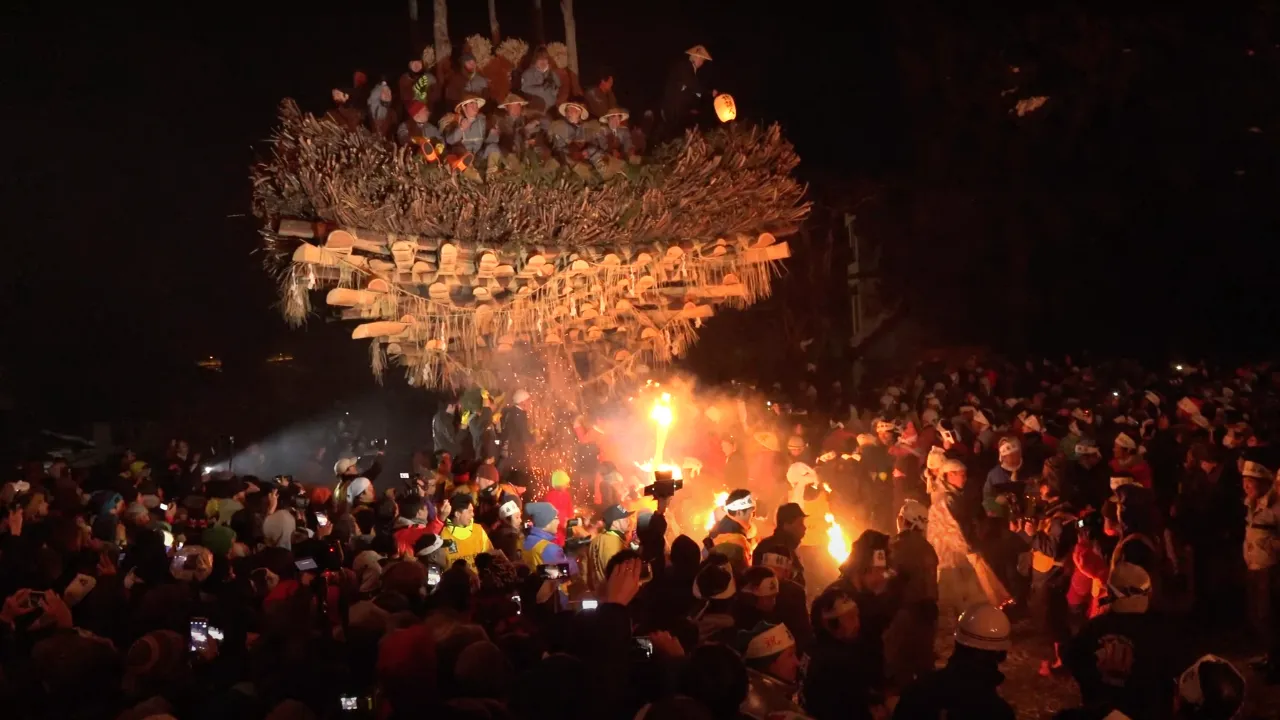
On January 15, men of the village defend and then burn an 18‑m wooden shrine in a roaring ritual for good harvests and health—among Japan’s fiercest fire festivals.
Flames, clash, and catharsis in deep winter
With 300+ years of history (National Important Intangible Folk Cultural Property), the festival centers on men aged 42 and 25 (traditional unlucky ages). They build a huge shrine framework, then battle torch‑bearers trying to set it alight. Chants of “Yoiyoi!” and “Nanyō!” echo as sparks fly through the night until the structure finally burns, purifying the year ahead.
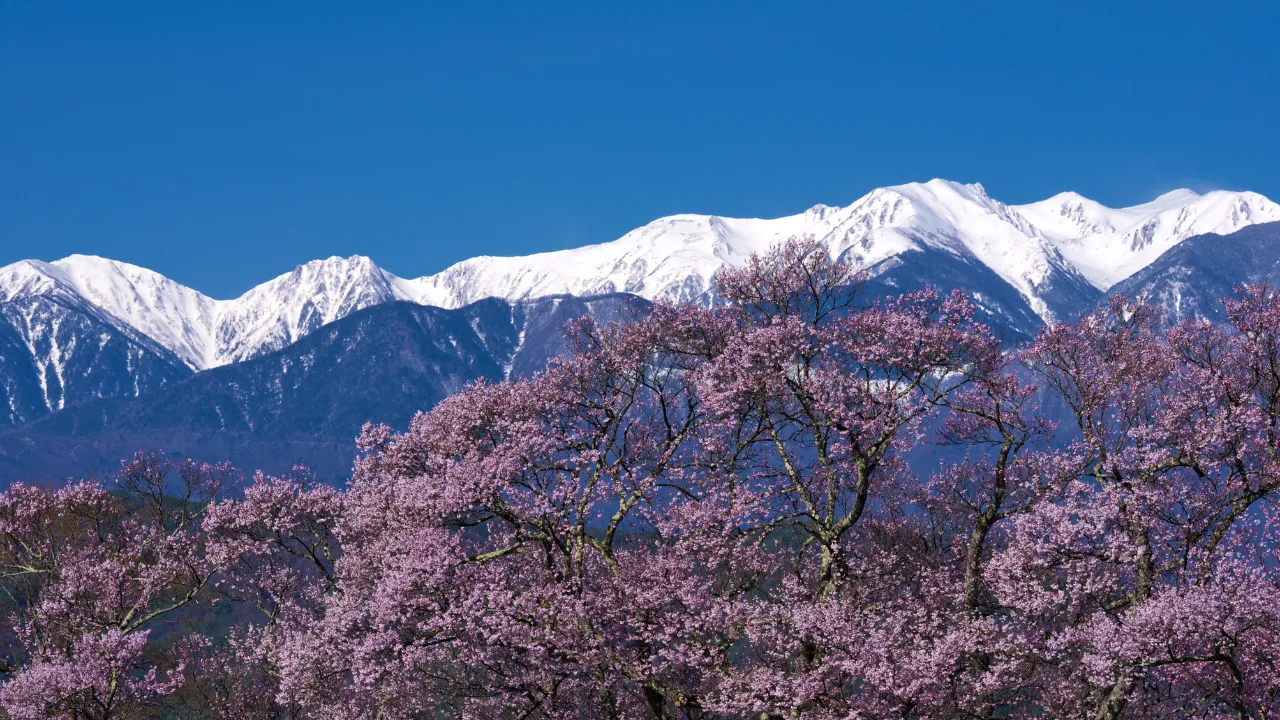
One of Japan’s “Top Three Cherry Blossom Spots.” About 1,500 Takato Kohigan trees bloom in a dense blush that turns the whole hill a soft pink.
Hills awash in rosy blossoms
The park in Ina City traces its sakura to plantings by the Naito lords in the Edo era. The local Kohigan variety has smaller, deeper‑colored petals that cluster thickly, earning the title “Japan’s number one sakura.”
During peak bloom the festival draws huge crowds; climb to viewpoints for sweeping pink canopies and stay for the evening illuminations—nighttime blossoms glow with quiet enchantment.

One of Japan’s great soba regions. Pure water and alpine climate yield fragrant noodles; styles vary by area—from Togakushi’s neat bundles to rustic Kiso strands.
Follow your nose to buckwheat heaven
Nagano’s cool climate and clean water have produced fine soba for centuries. On the old Nakasendō, Shinshu soba earned nationwide fame. Typical ratios are “ni‑hachi” (80% buckwheat, 20% binder), slurped lightly dressed to savor aroma and bite.
Try Togakushi’s tidy “bocchi‑mori” bundles with spicy daikon, or Kiso’s thicker, homey strands—sometimes spiked with chili instead of wasabi. Many towns offer soba‑making workshops; new‑crop noodles in autumn are especially perfumed.
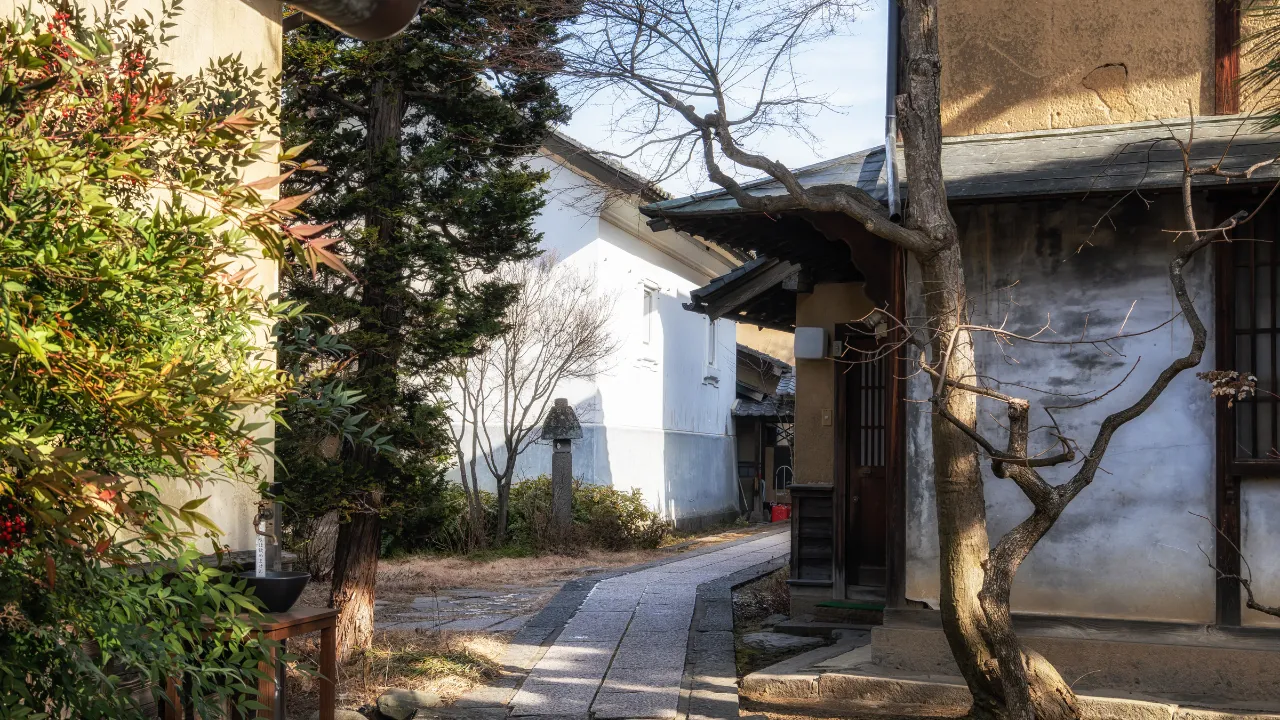
A compact town rich in art and sweets. The Hokusai Museum and other galleries mingle with historic storehouses; chestnut confections and cafés tempt at every corner.
Hokusai’s legacy and chestnut delights
Once a merchant hub, Obuse hosted Katsushika Hokusai late in life; his painted festival float ceilings and works like “Raging Waves” are displayed at the Hokusai Museum. Nearby galleries and museums explore local craft and art.
The town is famed for chestnuts—enjoy kuri‑okowa rice, wagashi, and creative pastries. With stone alleys and earthen‑walled kura storehouses, strolling here feels like stepping into a tasteful picture book.
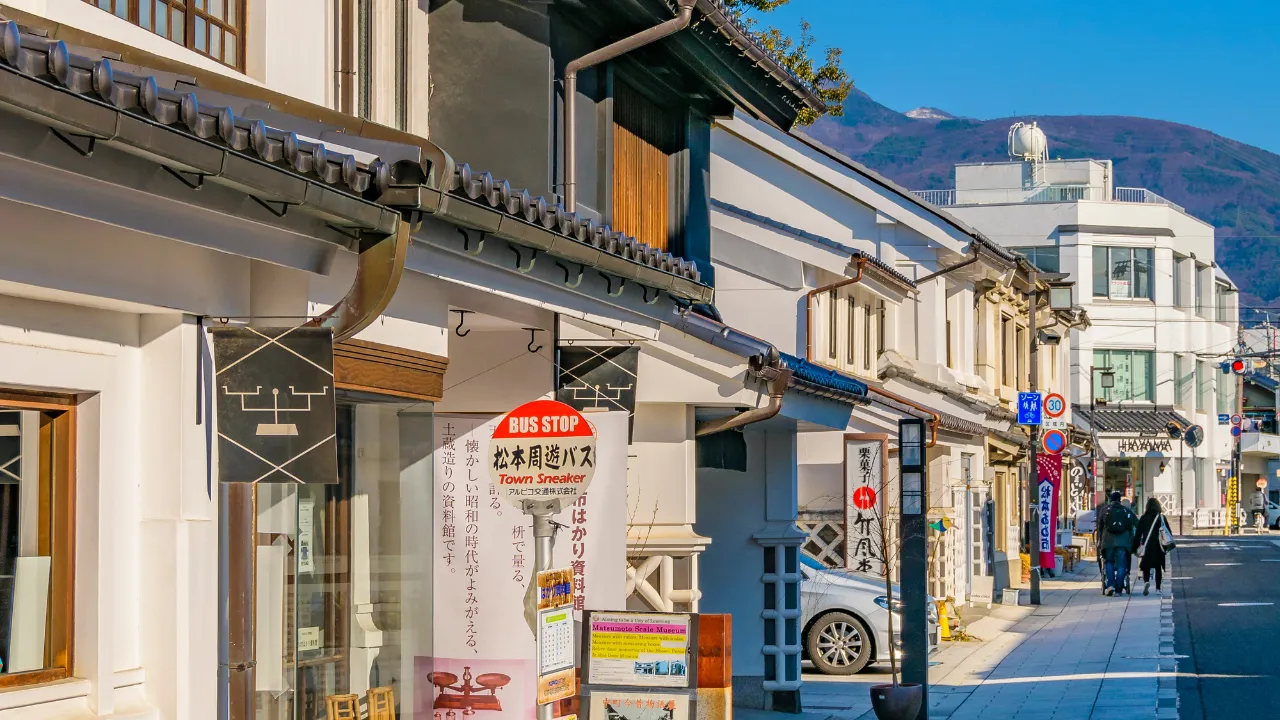
Historic shopping lanes near Matsumoto Castle. White‑walled storehouses line Nakamachi; frog‑themed Nawate brims with quirky shops, crafts, and snack stands.
Castle‑town shopping with character
Nakamachi prospered as a merchant district; its earthen‑walled kura buildings exude calm. Nawate runs along the Metoba River and celebrates all things frog—look for statues and the “Frog Shrine” at the Shinmei (Four Pillars) Shrine.
Browse antiques, folk craft, furniture, pottery, and fun souvenirs. Snack as you go—takoyaki, sweets, and more. A perfect detour from the castle.
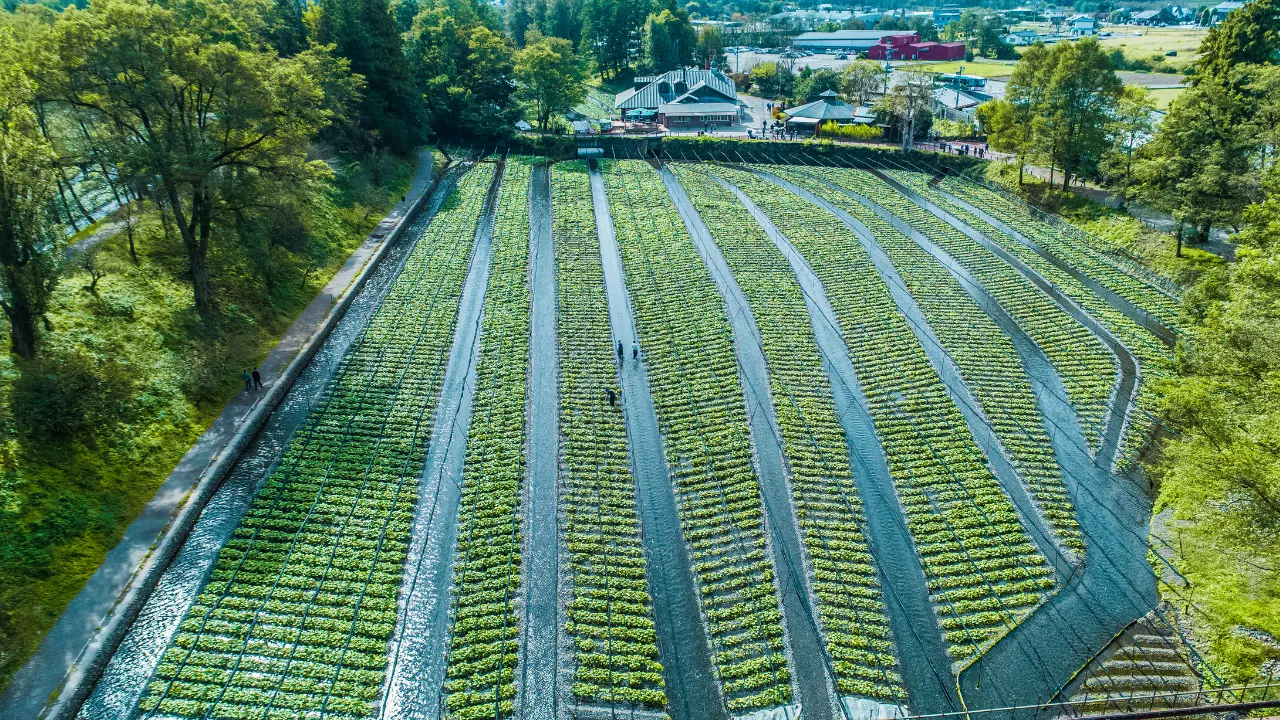
One of Japan’s largest wasabi farms nourished by the Northern Alps’ spring water. Stroll among watercress‑like beds and sample unique wasabi treats.
Where cold springs grow real wasabi
Spanning ~15 hectares, Daio’s lattice of channels cradles emerald‑green plants under the sound of running water. Waterwheels dot a pastoral scene used in films (including Kurosawa’s “Dreams”).
Try fresh‑grated wasabi on soba or in creative bites—soft‑serve, croquettes, even beer. A quintessential Azumino experience linking taste and landscape.
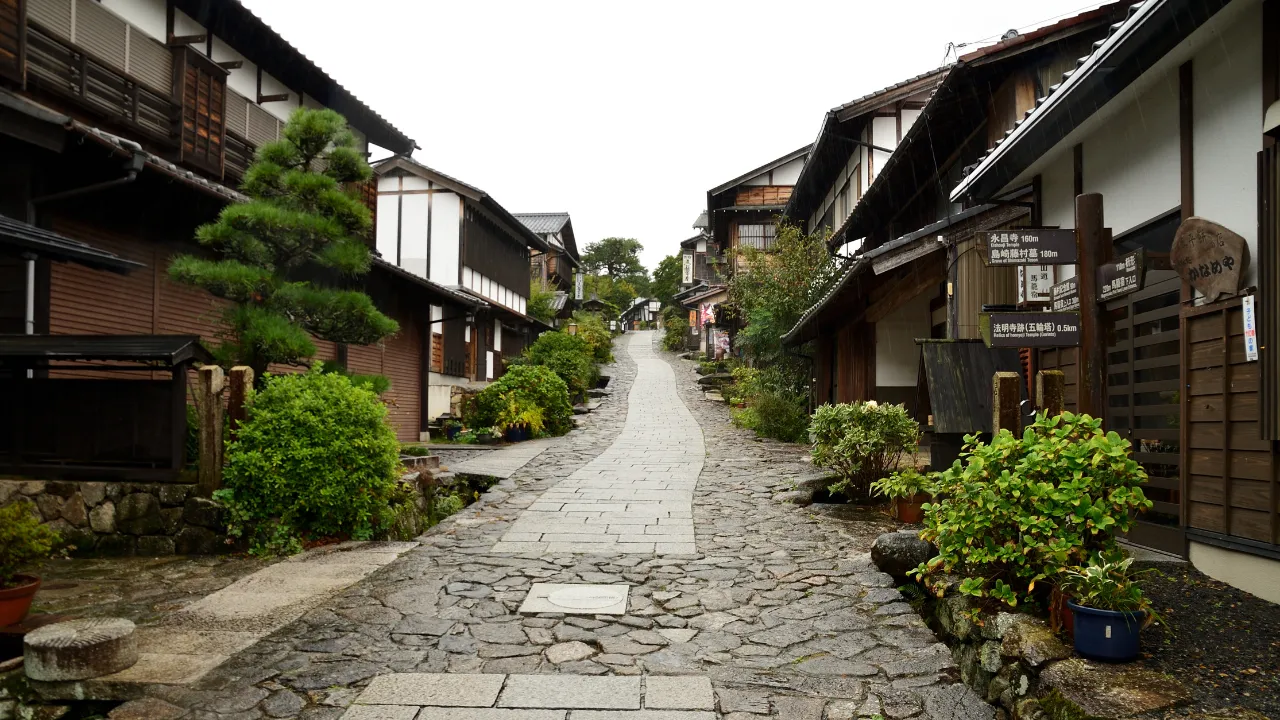
Three superb post towns along the Nakasendō’s rugged Kiso stretch. Edo streetscapes run almost unbroken—classic Japan writ large.
“Don’t sell, don’t rent, don’t destroy” preservation
Tsumago pioneered townscape conservation in the 1970s, burying power lines and standardizing wooden signage. Magome, hometown of author Shimazaki Tōson, cascades down a slope with sweeping valley views—immortalized in his novel “Before the Dawn.”
Narai, the “longest post town,” stretches for over a kilometer with lacquerware shops and workshops. Trails link the towns—walk the old cobbles trodden by couriers and processions, and pause at historic teahouses like Ichi‑okutōchi.

Three crystal‑clear lakes fed by alpine snowmelt. SUP, kayaking, and smelt fishing await year‑round.
Each lake, a different character
Aoki is Nagano’s deepest (58 m), mirroring the Alps at dawn—perfect for silent kayak cruises. Nakatsuna blooms with water lilies and irises in June and reflects spring blossoms along its banks. Kizaki is a smelt‑fishing mecca with dome boats in winter and rowboats in summer; it’s also an anime pilgrimage site.
A 15‑km cycling course threads birch woods around the shores; rentals make it easy for casual riders.
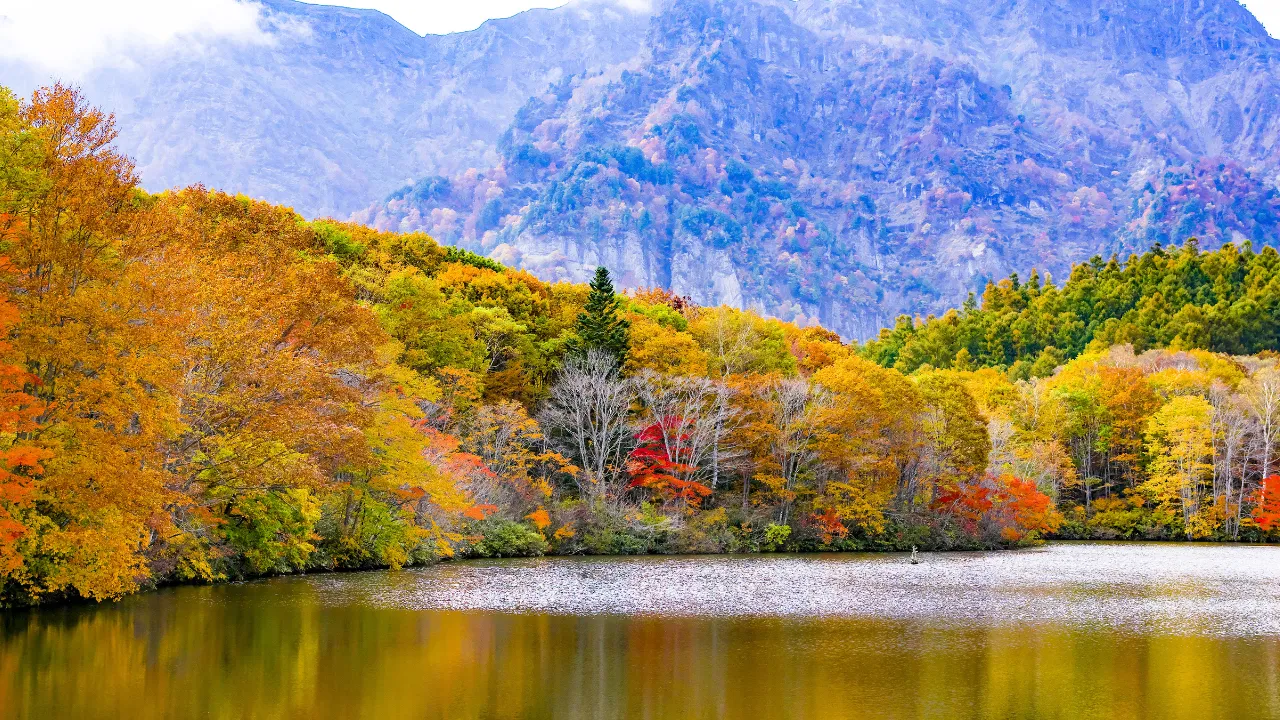
A natural mirror of the Togakushi peaks—especially sublime during autumn foliage.
Calm‑air reflections at their best
From 6–8 a.m. the water is often glassy, doubling mountains and maples. A 20‑minute loop path circles the pond through breezy beech woods. Nearby soba shops serve hand‑cut noodles with mountain‑vegetable tempura—perfect after a morning shoot. Check traffic restrictions during peak foliage.
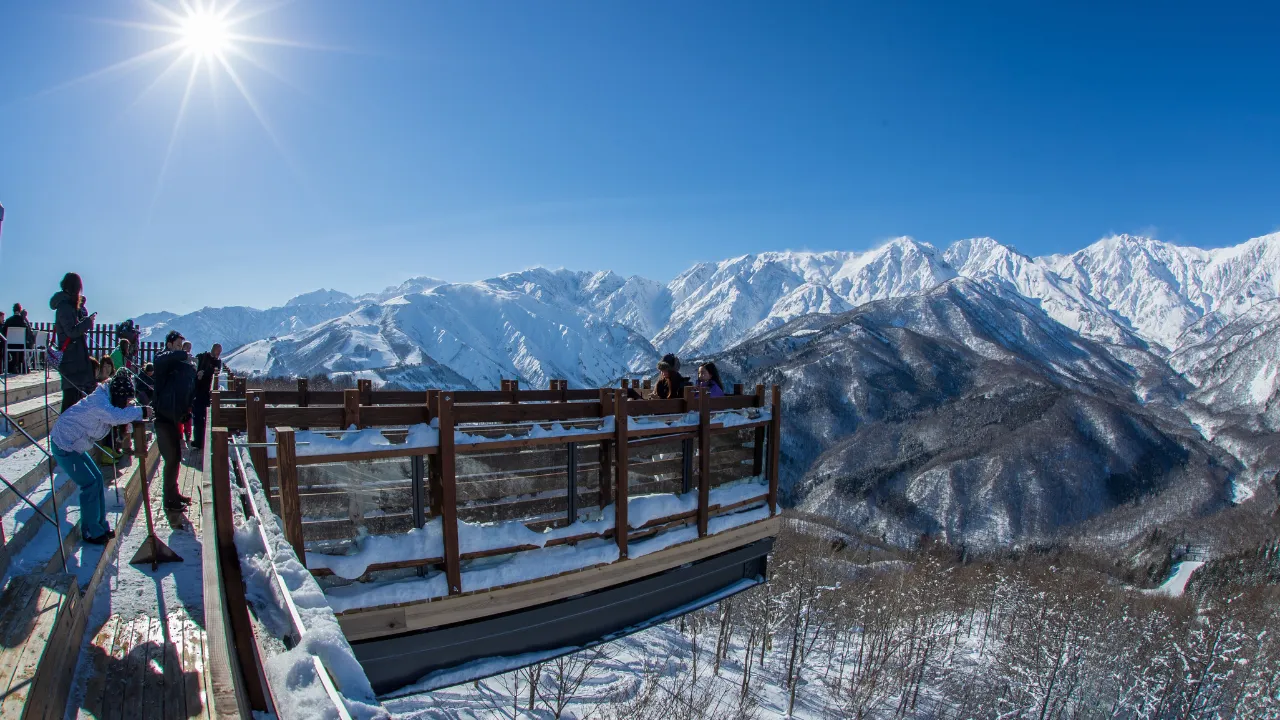
A summit terrace at 1,289 m with huge views of the Hakuba Sanzan. The giant swing and buttery pastries are social‑media darlings.
Cloud‑sea mornings and a mountaintop café
The gondola takes 8 minutes to the top. At HAKUBA MOUNTAIN HARBOR, savor world‑class croissants with a panorama that often floats above a sea of clouds.
The “YAHHO! Swing” launches you over a valley, and one of Japan’s largest permanent MTB downhill parks opens in summer (521 m vertical). In winter it’s a ski area; dog‑friendly gondolas make it a four‑season resort.
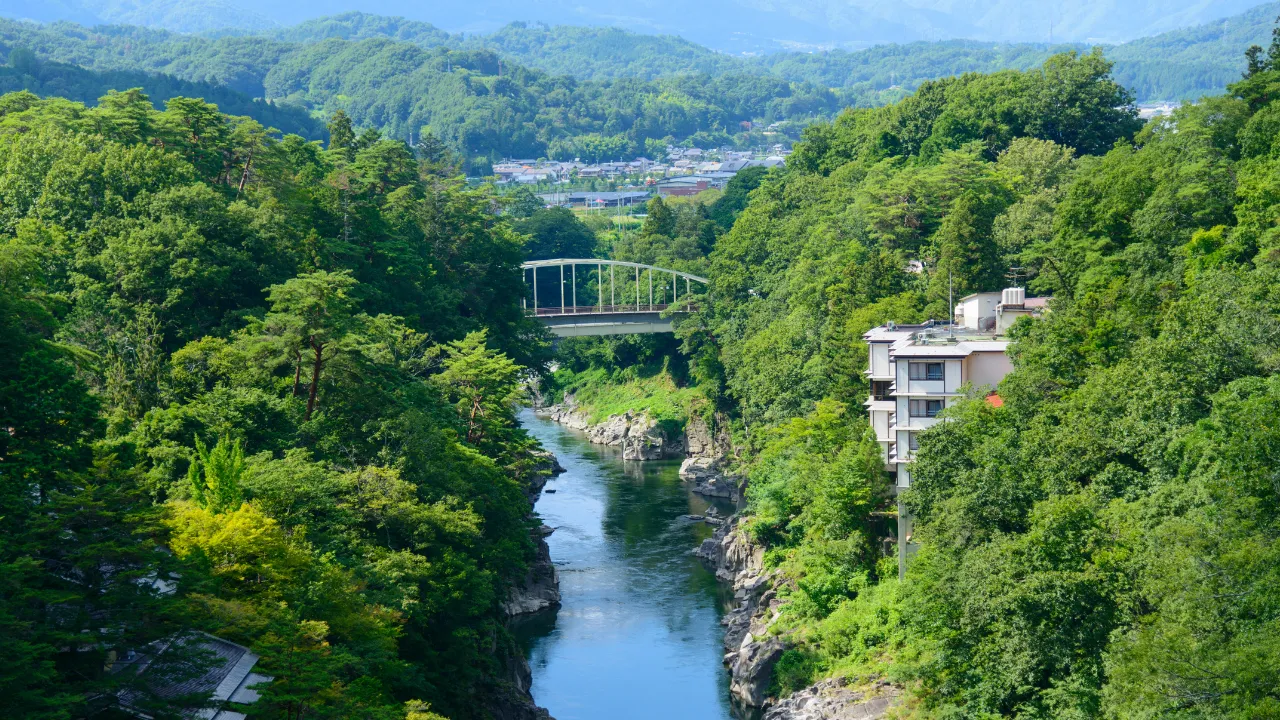
A grand gorge carved by the Tenryu River. See dragon‑back bends from boats and the 80‑m “Sora‑Sanpo Tenryukyo” pedestrian bridge.
Rising Dragon Bend & a sky‑high stroll
At the S‑curve “Shōryūkyō,” rock strata and seasonal colors resemble a dragon’s scales. The pedestrian bridge opened in 2019 spans ~80 m high; sightseeing boats glide far below. A scenic loop with the wooden Tsutsuji Bridge (modeled on Kintaikyō) takes about an hour. The local Iida Line train hugs the river for beautiful views.
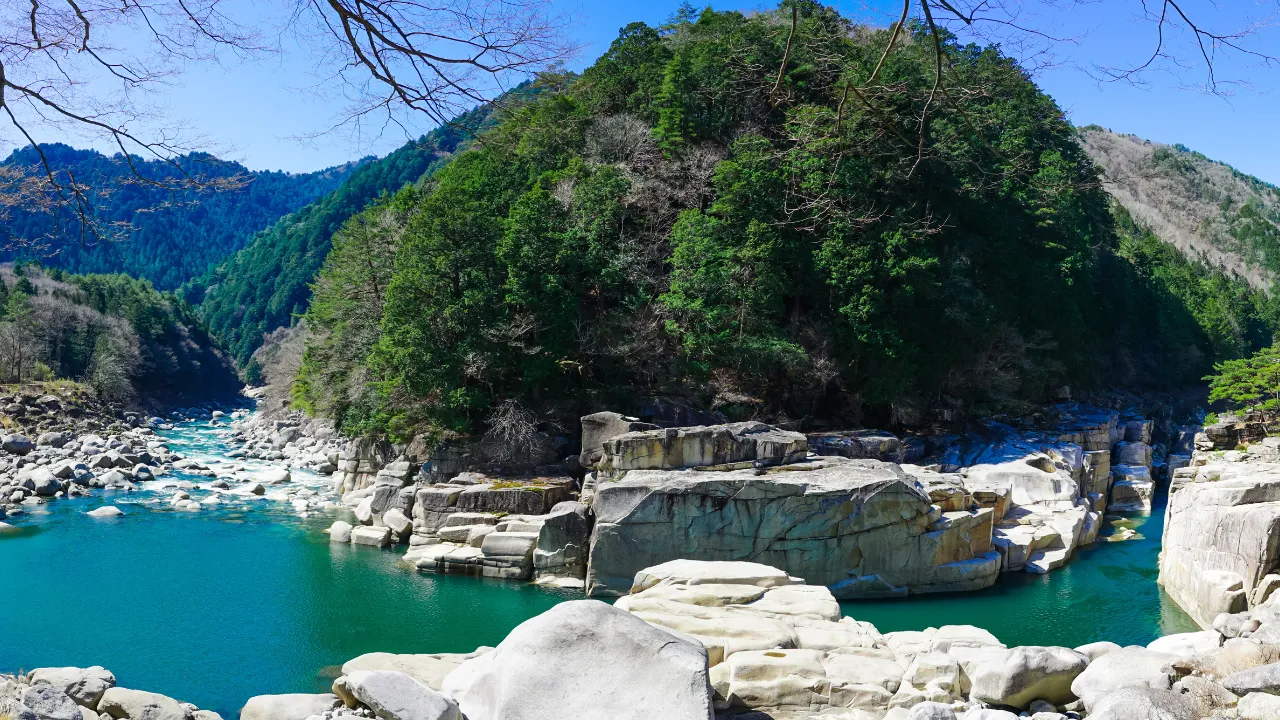
Giant granite slabs polished by the Kiso River form natural terraces. Emerald currents and white rock make vivid contrasts.
A scenic spot tied to the Urashima Tarō legend
Local lore says Urashima awoke here after opening his fateful box; a reliquary shaped like it is enshrined at nearby Rinsen‑ji. Clamber down to the waterline to admire the massive granite and cool shade—refreshing even in midsummer. JR Agematsu Station is a 15‑minute walk, making this a convenient gateway to the Central Alps National Park area.
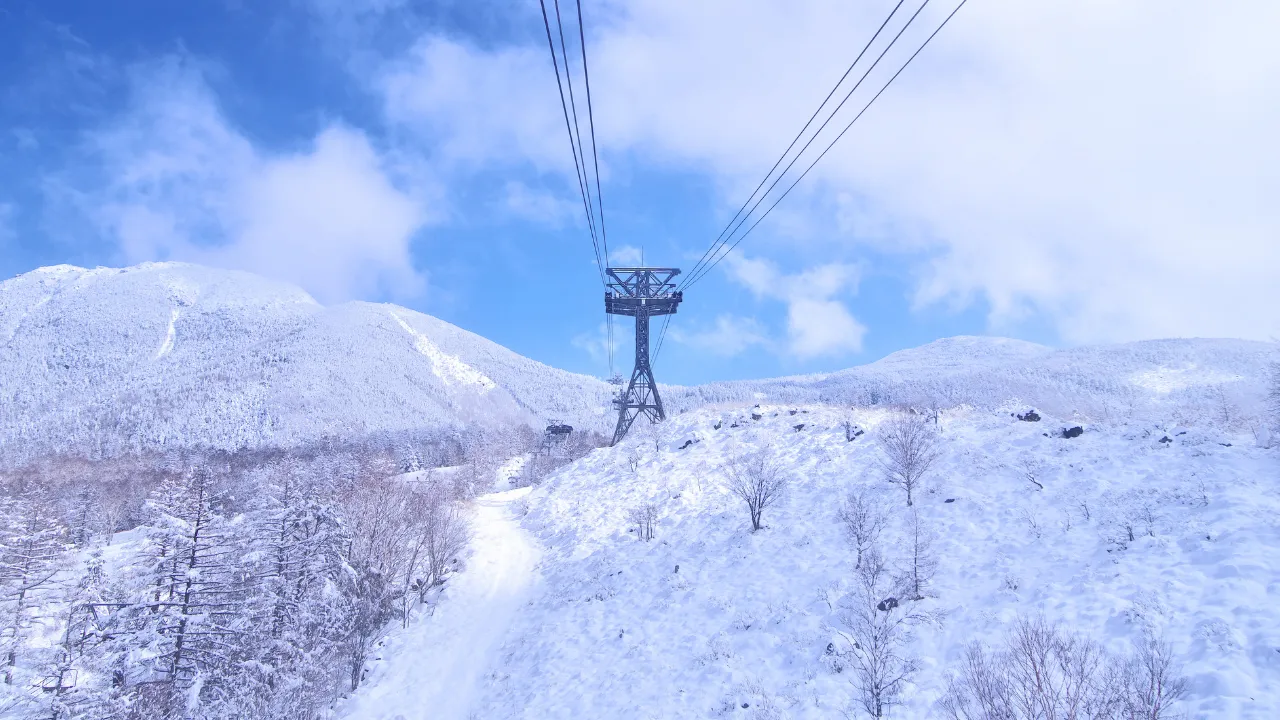
An airy 7‑minute ride climbs 466 m to the Tsuboniwa lava garden, rich with alpine flora and views of both the Central and Northern Alps.
Four‑season walks on a lava plateau
From the mountaintop station, a ~40‑minute loop circles Tsuboniwa. Summer brings carpets of tiny blooms; autumn sets the rowan ablaze; winter transforms the plateau into a snowshoe field with “snow‑monster” rime ice. The 100‑passenger cabins are stable and comfortable, and treats like lingonberry soft‑serve await at the base.

A 2,000‑m lava plateau of open pastures with 360° panoramas. Grazing cattle and a famous bell tower define this “sky pasture.”
Ring the Bell of Beauty
Built to guide travelers through fog, the “Utsukushi‑no‑tō” bell tower invites a safety chime from visitors. The 3‑km Alps Panorama course surveys all three Alps ranges, Yatsugatake, and even Fuji; dawn often brings seas of clouds. The open‑air Utsukushigahara Museum displays 350+ sculptures against alpine backdrops. At the mountaintop Ōgatō Hotel, sunrise often intersects stars and cloud seas—bucket‑list material.